
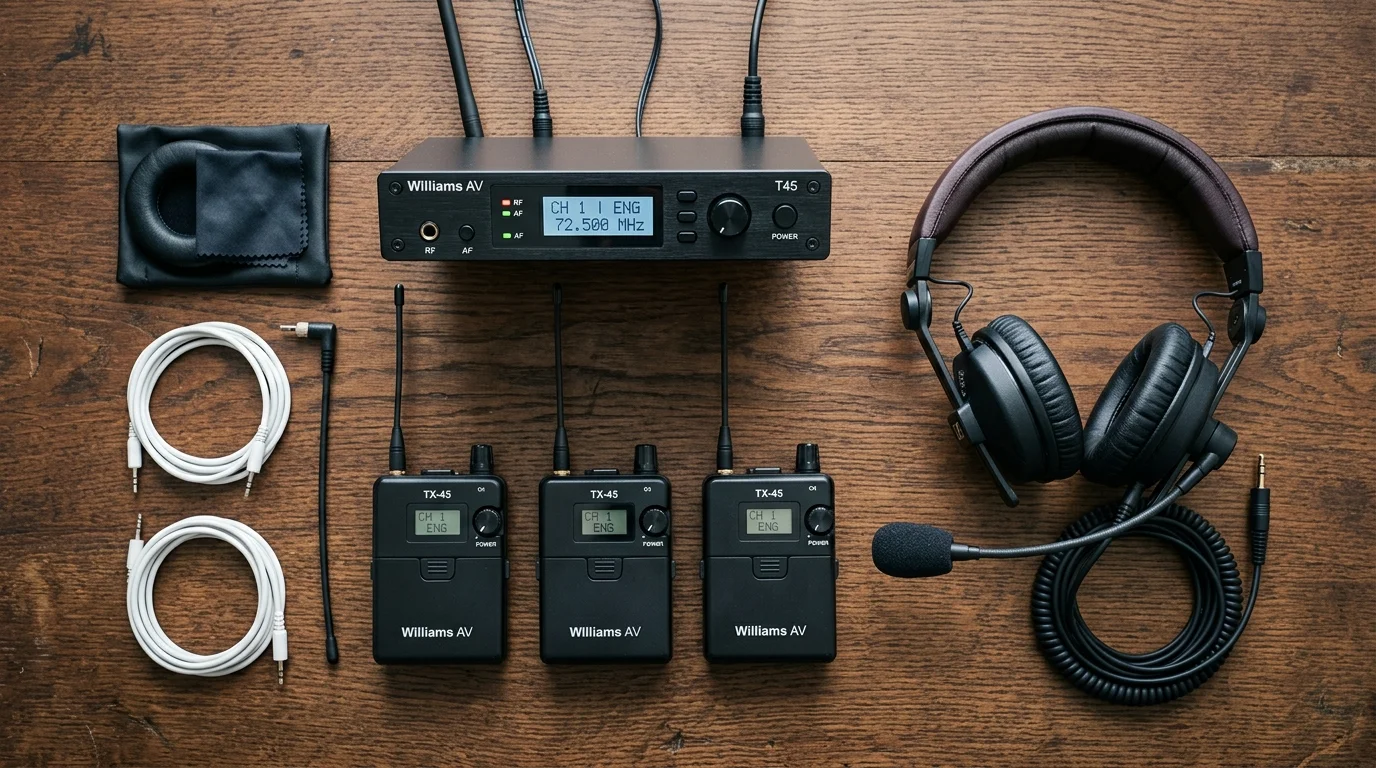
Best Wireless Translation Systems for Churches: 2026 Buyer’s Guide and Reviews
✨ This article was AI edited. Editorial responsibility: WesternChurch.net.
The best wireless translation systems for churches in 2026 are the Williams AV SoundPlus PPA series and the Listen Technologies iDSP 72 MHz system for permanent, zero-latency sanctuary installations, while the Retekess TT106 package provides an affordable portable solution for church plants and mobile ministries. Choosing the right equipment depends on sanctuary square footage, the number of target languages, budget constraints, and whether church leaders prefer distributing physical receiver bodypacks or streaming audio directly to congregants’ personal smartphones over local Wi-Fi.
Contents
- Top Church Translation Systems: Quick Comparison
- 1. Williams AV SoundPlus PPA Series: The Industry Standard
- 2. Listen Technologies iDSP 72 MHz: Premier Ergonomics and Precision
- 3. Wi-Fi Audio Gateways (WaveCAST & ListenWiFi): The BYOD Future
- 4. Retekess TT106 & TT122: High-Value Budget Solutions
- How to Calculate Total Cost of Ownership (TCO)
- Frequently Asked Questions
Top Church Translation Systems: Quick Comparison
Navigating the pro-audio translation market requires comparing frequency stability, battery longevity, multi-channel scalability, and total investment cost. The following table provides a direct side-by-side comparison of the four market-leading hardware solutions deployed across bilingual and multicultural assemblies:
| System Model | Transmission Type | Operating Frequencies | Max Simultaneous Channels | Typical System Cost | Best Suited For |
|---|---|---|---|---|---|
| Williams AV SoundPlus (PPA T45) | VHF RF Radio | 72–76 MHz | 17 selectable frequencies | $3,800 – $6,500 | Mid-to-large traditional auditoriums; bulletproof RF reliability |
| Listen Technologies iDSP (LT-800) | VHF RF Radio | 72 MHz or 216 MHz | 57 selectable channels | $4,200 – $7,200 | Metropolitan multi-language campuses; ADA compliant assistive listening |
| WaveCAST Eight (Williams AV) | Wi-Fi LAN Streaming | 2.4 GHz / 5 GHz Wi-Fi | Up to 8 simultaneous audio streams | $5,500 – $9,000 | Modern congregations where attendees use personal smartphones and earbuds |
| Retekess TT106 Portable System | UHF Digital Spread | 2.4 GHz ISM Band | 99 channels | $600 – $1,400 | Church plants, traveling mission groups, and tight annual budgets |
1. Williams AV SoundPlus PPA Series: The Industry Standard
Williams AV (formerly Williams Sound) has engineered assistive listening and simultaneous interpretation hardware for over four decades. The PPA T45 base station transmitter paired with PPA R37 or R38 bodypack receivers represents the quintessential workhorse of American and European houses of worship.
Key Architectural Strengths
- Powerful RF Range: The stationary T45 transmitter pushes an adjustable radio signal reaching up to 1,000 feet, effortlessly penetrating thick stone masonry, reinforced concrete pillars, and multi-tier balcony structures without dropouts.
- Microprocessor-Controlled OLED Display: Sound operators can easily assign channel names (e.g., “Spanish,” “Korean,” “Hearing Assist”) and calibrate input levels directly from the front panel.
- Universal Audio I/O: Accepts balanced XLR, 1/4-inch TRS line level, or mic-level inputs directly from the main sanctuary mixing console, featuring a built-in soft compressor/limiter that protects listeners’ ears from unexpected vocal spikes.
- Extended Receiver Battery Life: The beltpack receivers operate for up to 50 hours on standard alkaline AA batteries, or up to 32 hours with rechargeable NiMH batteries charged in multi-unit drop-in docks.
2. Listen Technologies iDSP 72 MHz: Premier Ergonomics and Precision
Listen Technologies has carved out a premier reputation for sleek industrial design and exceptional audio intelligibility. The Listen iDSP (Intelligent Digital Signal Processing) series addresses common hardware frustrations experienced by church hospitality volunteers.
Advanced Capabilities
- Ultra-Compact Bodypacks (LR-4200-072): Weighing less than 2 ounces, these lithium-ion powered units can be clipped to a belt, slipped into a shirt pocket, or worn on an included lanyard. Integrated OLED displays confirm channel names and battery status.
- Advanced Noise Canceling: Proprietary SQ (Super Quiet) squelch technology cuts out hiss and static when the interpreter pauses between sentences, providing clear vocal presence.
- Smart Charging Trays: The 12-bay and 24-bay charging stations not only replenish batteries within 2.5 hours but also feature automated firmware updates and batch channel programming via USB.
3. Wi-Fi Audio Gateways (WaveCAST & ListenWiFi): The BYOD Future
For tech-forward churches seeking to avoid the recurring logistical friction of collecting, charging, sanitizing, and replacing lost hardware receivers, Bring Your Own Device (BYOD) Wi-Fi streaming servers offer an elegant digital alternative.
Operational Mechanics
Hardware servers such as the Williams AV WaveCAST Eight or ListenWiFi LW-320 connect directly into the church’s local gigabit network switch. The server transcodes multi-channel analog inputs into low-latency RTP/UDP digital audio streams:
- Attendees download the free iOS or Android listening app prior to or upon entering the sanctuary.
- The user connects to the church’s dedicated 5 GHz “Worship Audio” Wi-Fi SSID.
- Upon launching the app, available audio streams are automatically detected. Congregants tap “Spanish Translation” or “Mandarin Translation” and listen using their own smartphone earbuds or Bluetooth hearing aids.
Consideration: Wi-Fi systems require robust commercial wireless access points (such as Ubiquiti UniFi, Cisco Meraki, or Aruba) configured with Quality of Service (QoS) prioritization to prevent audio buffering when hundreds of mobile devices connect simultaneously.
4. Retekess TT106 & TT122: High-Value Budget Solutions
Smaller congregations, immigrant fellowship groups, and church plants operating in leased school auditoriums often cannot justify a $5,000 capital expenditure. For these ministries, UHF digital packages like the Retekess TT106 system provide exceptional value.
Operating in the 2.4 GHz digital band with frequency-hopping spread spectrum technology, the system includes a compact transmitter worn on an interpreter’s ear or lanyard, paired with ultra-lightweight ear-hook receivers. Complete packages with 2 transmitters, 30 receivers, and an aluminum flight charging case frequently retail under $1,200, making multi-language ministry accessible to communities with modest budgets.
How to Calculate Total Cost of Ownership (TCO)
When presenting a translation equipment proposal to a church board or finance committee, factor in the complete operational ecosystem beyond the base transmitter:
- Transmitter & Antennas (30%): Base station, rack-mount kit, coaxial cable run, and remote wall-mounted dipole antenna to eliminate RF shadows.
- Interpreter Environment (20%): Dual-interpreter switching console, heavy-duty broadcast headsets (like the Audio-Technica BPHS1), and sound-dampened tabletop partition booth.
- Receivers & Accessories (40%): Minimum of 15 to 30 bodypacks, dual-ear headphones, sanitary single-use earbud covers, and inductive neckloops for hearing aid compliance.
- Charging Infrastructure (10%): Multi-bay drop-in docking chargers that eliminate disposable alkaline battery expenses.
Frequently Asked Questions
What is the most reliable frequency band for church translation systems?
The 72 MHz VHF band remains the most reliable standard for houses of worship in the United States. It offers excellent wall penetration, does not compete with crowded 2.4 GHz or 5 GHz Wi-Fi frequencies, and does not require an FCC operational license.
How many receivers should our church purchase initially?
A practical rule of thumb is to purchase receivers equal to 10% to 15% of your non-English-speaking or hard-of-hearing average weekly attendance, with a minimum baseline of 10 to 15 units to accommodate visiting families and special outreach events.
Can attendees use their own Bluetooth hearing aids with church translation?
Yes. Attendees using modern Bluetooth-enabled hearing aids or cochlear implants can either connect directly via smartphone apps in Wi-Fi BYOD installations, or use an inductive telecoil (T-coil) neckloop plugged into a standard RF bodypack receiver.
Do volunteer interpreters need special audio consoles?
While an interpreter can technically speak into a standard handheld microphone, dedicated interpreter consoles provide essential mute/cough buttons, volume controls, and dual-microphone switching that make prolonged 40-minute sermons far more manageable.
Get our latest guides, news, and insights highlighted in your Google Search & AI Overviews.




 URGENT: THIS PAGE COULD DISAPPEAR!