
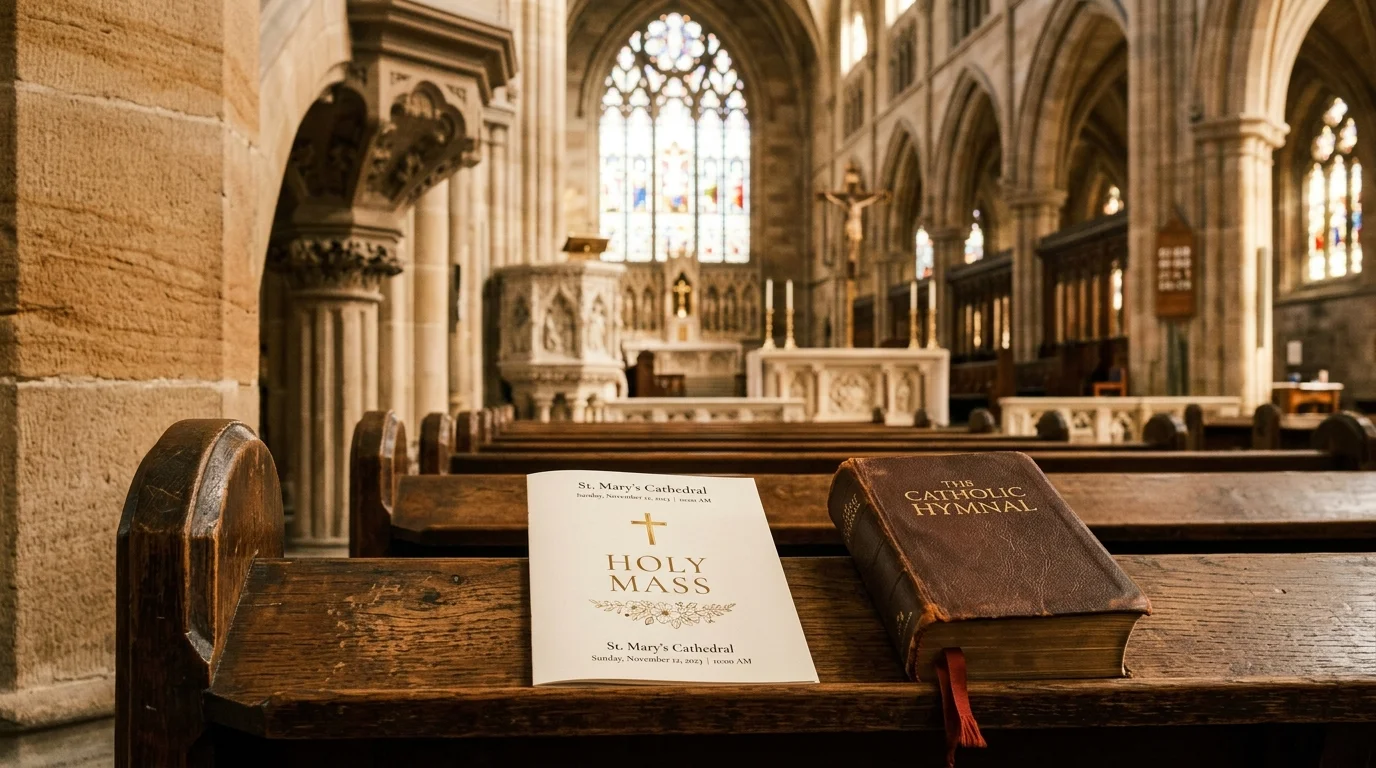
Catholic Mass Program Guide: Order of Service, Wedding Bulletins, and Printable Templates
✨ This article was AI edited. Editorial responsibility: WesternChurch.net.
A Catholic Mass program (also called a worship aid or order of service bulletin) is a printed booklet or handout that guides the congregation through the liturgical prayers, scripture readings, hymns, and sacramental actions of the Mass. Most commonly created for special celebrations such as Nuptial Wedding Masses, Funerals, Confirmations, and First Holy Communions, an effective program helps guests of all religious traditions understand when to stand, sit, or kneel, while explaining reverent participation during the Liturgy of the Eucharist.
Contents
When and Why Catholic Mass Programs Are Used
In standard Sunday parish celebrations, worshippers frequently rely on permanent pew hymnals (such as the Gather hymnal, Breaking Bread, or the Adoremus Hymnal) alongside a weekly parish bulletin containing announcements. However, when a Mass involves extensive visitor attendance—most notably Catholic weddings and funeral liturgies—a personalized printed program becomes essential.
A well-crafted program serves three practical and theological purposes:
- Active Liturgical Participation: In keeping with the Second Vatican Council’s directive for the “fully conscious and active participation” of all the faithful (Sacrosanctum Concilium), the booklet prints the spoken congregational responses and sung refrains.
- Hospitality for Non-Catholic Guests: Provides respectful, clear explanations of Catholic postures (genuflecting, kneeling) and communicates delicate sacramental guidelines regarding Holy Communion.
- Sacred Keepsake: Commemorates a sacramental milestone, preserving the names of the celebrant, concelebrants, liturgical ministers, bridal party, or memorialized loved ones.
| Program Section | Liturgical Component | Congregational Posture | Typical Contents Printed in Program |
|---|---|---|---|
| Introductory Rites | Processional & Opening Prayers | Standing | Processional Hymn, Sign of the Cross, Penitential Act, Gloria |
| Liturgy of the Word | Scripture Readings & Homily | Sitting / Standing (Gospel) | First Reading citation, Psalm refrain, Second Reading, Gospel, Creed |
| Liturgy of the Eucharist | Offertory & Consecration | Sitting / Kneeling | Offertory Hymn, Holy Holy Holy (Sanctus), Memorial Acclamation, Great Amen |
| Communion Rite | Eucharist & Thanksgiving | Standing / Kneeling | The Lord’s Prayer, Lamb of God (Agnus Dei), Communion Guidelines, Hymns |
| Concluding Rites | Blessing & Dismissal | Standing | Final Blessing, Dismissal, Recessional Hymn title & composer |
Standard Structure of a Catholic Mass Program (Step-by-Step)
Whether designing a folded four-page bifold booklet or a comprehensive multi-page pamphlet, the program follows the canonical order of the Roman Missal:
1. Cover Page
The front cover sets a dignified, reverent tone. It traditionally includes:
- Title of the Liturgy (e.g., “The Nuptial Mass Uniting [Bride] and [Groom] in Holy Matrimony” or “Mass of Christian Burial for [Name]”).
- Name of the Parish Church, City, and State.
- Date and Time of the Liturgy.
- Names of the Presiding Priest / Bishop, Deacon, Altar Servers, and Organist/Cantor.
2. The Introductory Rites
This opening movement gathers the community into a single worshipping body:
- Prelude: Instrumental sacred music selections.
- Entrance Procession & Hymn: Title, hymnal number, and lyrics of the opening hymn.
- Greeting & Penitential Act: The priest’s invocation, the Sign of the Cross, and the recitation of the Confiteor (“I confess to almighty God…”) or the Kyrie eleison (“Lord, have mercy”).
- The Gloria: The text or musical score of the hymn of praise (recited or sung on Sundays and solemn feast days).
- The Collect: The opening presidential prayer uttered by the priest.
3. The Liturgy of the Word
During this portion, God speaks to His people through sacred scripture. The program typically lists biblical book, chapter, and verse references alongside the names of the appointed lectors:
- First Reading: Citation (e.g., Genesis 2:18–24 or Song of Solomon 2:8–10).
- Responsorial Psalm: The sung congregational response refrain (e.g., “The earth is full of the goodness of the Lord”).
- Second Reading: Citation from the New Testament Epistles (e.g., 1 Corinthians 12:31–13:8).
- Gospel Acclamation: The Alleluia verse.
- The Holy Gospel: Proclaimed by the deacon or priest (e.g., John 15:9–12).
- The Homily: Pastoral reflection.
- The Nicene Creed / Renewal of Vows: In wedding programs, the Rite of Marriage (Consent, Exchange of Rings, and Nuptial Blessing) takes place here.
- Universal Prayer: General intercessions read by a lector.
4. The Liturgy of the Eucharist
The sacramental summit of the celebration:
- Preparation of the Altar: Offertory hymn title.
- Sanctus (Holy, Holy, Holy): Sung by all in English or Latin.
- The Eucharistic Prayer: The program instructs the congregation to kneel during the consecration of the bread and wine into the Body and Blood of Christ.
- Memorial Acclamation & Great Amen: The sung affirmations of faith.
5. The Communion Rite and Etiquette Note
This crucial section guides worshippers through the distribution of the Sacrament:
- The Lord’s Prayer & Sign of Peace: Worshippers offer an exchange of peace.
- Agnus Dei (Lamb of God): Sung litany preceding communion.
- Guidelines for Receiving Communion: A sensitive, standard note issued by the United States Conference of Catholic Bishops (USCCB) explaining that Holy Communion is reserved for Catholics in good standing, while welcoming non-Catholic guests to pray or come forward for a blessing.
- Communion Hymns & Meditation: Titles and lyrics of songs during the Eucharistic distribution.
6. Concluding Rites and Back Cover
The program concludes with the final priestly blessing, dismissal, and the recessional hymn, followed by expressions of gratitude from the family to the parish clergy, musicians, and guests.
Sample Communion Guidelines Text for Programs
To avoid awkward moments during weddings or funerals, including this gracious, standard USCCB-approved explanation is strongly recommended:
A Note on Holy Communion:
For Catholics, Holy Communion is the summit and source of our faith, signifying our complete union in belief, worship, and life with the Catholic Church. While guests not of the Catholic faith or those unprepared to receive the Eucharist cannot receive Communion, all are warmly invited to join in singing and prayer. Those who wish may come forward with their arms folded across their chests to receive a blessing from the priest.
Design and Printing Tips for Liturgical Programs
When preparing programs for print, follow these best practices:
- Font Hierarchy: Use elegant, easily readable serif typography (such as Garamond, Caslon, or Minion Pro) sized at 10pt to 11pt with generous line spacing. Avoid overly cursive or decorative script fonts for liturgical prayers.
- Posture Cues: Place brief italicized notes in brackets before major sections to guide visitors—e.g., [Please Stand], [Please Be Seated], [Please Kneel].
- Copyright Permissions: If printing complete lyrics or musical notation for copyrighted hymns, ensure your parish holds an active OneLicense or CCLI streaming and reprint license.
- Paper Stock: Choose heavy 80lb or 100lb text-weight linen or matte paper in warm cream or soft natural white for a refined, glare-free finish.
Frequently Asked Questions
What is a Catholic Mass program called?
In addition to “Mass program,” it is formally referred to in liturgical circles as a “worship aid” or an “Order of Mass booklet.” In parish administration, weekly handouts are termed “parish bulletins.”
Do you need a Mass program for a regular Sunday Mass?
No. Regular Sunday Masses typically utilize the permanent hardbound hymnals and missalettes located in the pew racks, accompanied by the weekly church announcements bulletin.
Should non-Catholic wedding guests take Communion?
Under Catholic canon law, non-Catholic guests do not receive the consecrated Eucharist. However, programs typically invite guests to come forward with their arms crossed over their chests to receive a personal priestly blessing.
What are the four main parts of the Catholic Mass?
The four primary movements of the Mass are the Introductory Rites, the Liturgy of the Word, the Liturgy of the Eucharist, and the Concluding Rites.
Get our latest guides, news, and insights highlighted in your Google Search & AI Overviews.


 THE SECRET ELITES DON'T WANT YOU TO KNOW