
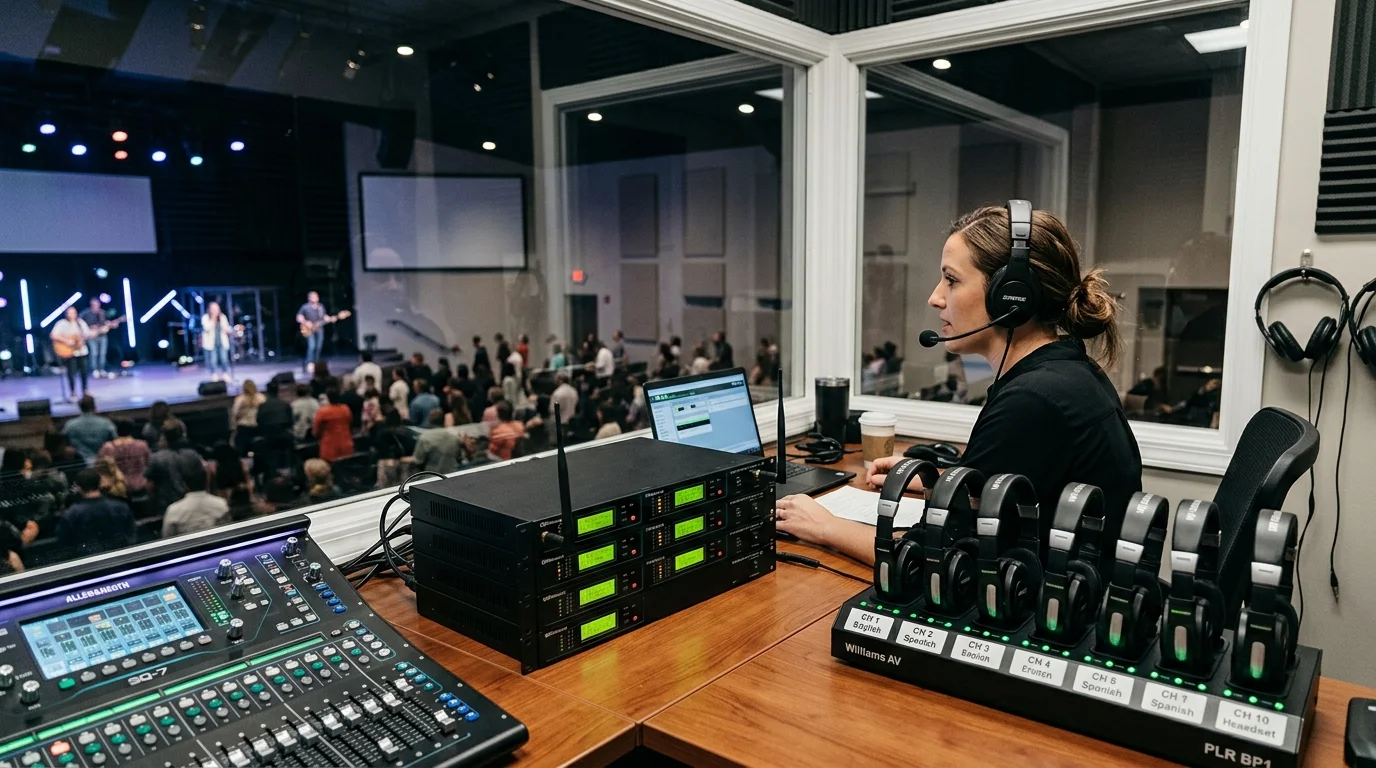
Translation Equipment for Churches: Simultaneous Interpretation Systems, RF Headsets, and Wi-Fi Audio
✨ This article was AI edited. Editorial responsibility: WesternChurch.net.
Translation equipment for churches encompasses simultaneous interpretation hardware systems—primarily multi-channel Radio Frequency (RF) transmitters, dedicated bodypack receivers with headsets, and low-latency Wi-Fi audio streaming gateways—that broadcast translated sermons in real time to multilingual congregants. While traditional RF systems (72 MHz and 216 MHz) deliver reliable, zero-latency transmission without internet dependence, modern Wi-Fi systems allow attendees to listen on their personal smartphones via dedicated church apps, significantly lowering per-seat hardware costs.
Contents
- Hardware Architectures: Comparing RF, Infrared, and Wi-Fi Streaming
- Core Components of a Church Simultaneous Interpretation System
- Step-by-Step Audio Routing Guide for Sound Technicians
- Dual Benefit: ADA Compliance and Assistive Listening
- Budget Guidelines and Brand Recommendations
- Frequently Asked Questions
Hardware Architectures: Comparing RF, Infrared, and Wi-Fi Streaming
Selecting the optimal church translation setup requires balancing acoustic clarity, latency, building architecture, and equipment management. Contemporary houses of worship deploy three primary technology tiers to support multilingual worship services:
| System Technology | Primary Transmission Medium | Typical Range | Pros for Churches | Limitations |
|---|---|---|---|---|
| Radio Frequency (RF 72/216 MHz) | VHF / UHF Radio Waves | 300–1,000 feet | Zero latency; penetrates walls; simple bodypack operation; no network reliance | Requires maintaining, charging, and sanitizing physical handheld receivers |
| Wi-Fi Audio / BYOD Gateway | Local 5 GHz Wi-Fi Network | Sanctuary Wi-Fi footprint | Congregants use personal smartphones and earbuds; limitless listener capacity | Buffer latency (40–120ms); requires enterprise-grade wireless access points |
| Infrared (IR) Systems | Pulsed Light Diodes | Line-of-sight only | High security; zero bleed-through between rooms; immune to radio interference | Blocked by architectural pillars; sunlight interference through stained glass |
| Digital 900 MHz / 2.4 GHz | Encrypted Digital Spread-Spectrum | 150–300 feet | Two-way communication capability; crystal-clear audio; secure encryption | Crowded 2.4 GHz spectrum can suffer interference from campus Wi-Fi networks |
Core Components of a Church Simultaneous Interpretation System
A professional church interpretation ecosystem consists of four interconnected hardware layers:
1. Audio Ingestion and Interpreter Consoles
The system begins with capturing the preacher’s voice cleanly from the main soundboard (FOH mixer). An auxiliary output (AUX send) routes a dedicated monitor mix into the interpreter’s headphones. The human translator sits in an isolated acoustic booth or quiet control room equipped with an interpreter console (such as the Williams AV IC-2 or Listen Technologies LT-800). The console features a noise-canceling broadcast headset, mute/cough buttons, and dual-relay switching for two interpreters trading thirty-minute shifts.
2. The Central Transmitter Unit
The audio signal from the interpreter’s microphone feeds directly into the stationary transmitter. Base station transmitters operate on selectable frequencies, allowing churches with diverse demographics to broadcast Spanish, Portuguese, Vietnamese, or American Sign Language audio descriptions across separate dedicated channels simultaneously.
3. Listener Reception (Dedicated Receivers vs. Smartphones)
Congregants access the translation audio via one of two workflows:
- Dedicated Bodypack Receivers: Small battery-powered receivers (like the ListenTech LR-4200 or Williams AV PPA R37) tuned to specific channels, paired with single-ear earbuds or neckloops for hearing-aid telecoils (T-coils).
- Smartphone Streaming (BYOD): Hardware servers (like Listen Technologies WaveCAST or AudioFetch Express) convert analog audio into digital unicast/multicast streams over the sanctuary’s local Wi-Fi. Attendees connect to the church guest network, open the mobile app, plug in their headphones, and choose their language.
4. Multi-Bay Charging and Sanitation Stations
Churches utilizing physical receivers require drop-in charging trays (12-bay or 24-bay docks) stationed at the information or welcome desk. This ensures units remain fully charged between Sunday services and facilitates quick sanitization of silicone earpieces and lanyards.
Step-by-Step Audio Routing Guide for Sound Technicians
Integrating translation hardware into an existing sanctuary soundboard requires clean gain staging to prevent distortion in the interpreter’s ears:
- Isolate Preacher’s Vocal: Route the pastor’s wireless microphone channel to a pre-fader auxiliary send (AUX) dedicated solely to the translation feed. Do not include loud musical instruments, drums, or congregational ambient microphones in this feed.
- Interpreter Return to Transmitter: Connect the line-out from the interpreter console directly into the balanced XLR or 1/4-inch line input of the RF or Wi-Fi transmitter.
- Gain Calibration: Set the transmitter input gain so that nominal speech levels peak around -6 dB on the visual VU meter, avoiding hard clipping or compressor pump.
- Acoustic Isolation: Position the interpreter booth away from sanctuary subwoofers and stage spill. Even the best noise-canceling headsets pick up low-frequency bass reverberation if the translator is placed in the main nave.
Dual Benefit: ADA Compliance and Assistive Listening
An added operational and legal benefit of investing in RF translation equipment is compliance with the Americans with Disabilities Act (ADA) and International Building Code (IBC) requirements. In the United States, assembly areas with audio amplification systems must provide assistive listening systems for hard-of-hearing attendees.
By utilizing a multi-channel transmitter, Channel 1 can carry amplified sanctuary audio directly to assistive listening receivers, while Channel 2 and Channel 3 broadcast Spanish and Ukrainian translations. Equipping a percentage of your receivers with inductive neckloops satisfies federal accessibility mandates while simultaneously serving multilingual families.
Budget Guidelines and Brand Recommendations
Church translation installations generally fall into three investment tiers:
- Entry-Level / Portable ($1,200 – $2,500): Portable beltpack transmitter with a head-worn mic and 4 to 8 portable receivers. Ideal for church plants, mobile classrooms, or visiting missionary groups. Brands: Enersound, Retekess, Williams AV Pocketalker.
- Mid-Size Sanctuary System ($3,500 – $7,000): Stationary rack-mount 72 MHz transmitter, directional antenna, sound-dampened tabletop booth, interpreter console, and 16 to 24 rechargeable bodypacks with multi-charger trays. Brands: Williams Sound SoundPlus, Listen Technologies iDSP.
- Enterprise Hybrid Campus ($8,000 – $18,000+): Multi-channel Wi-Fi streaming server (WaveCAST Eight), dedicated Wi-Fi access points, built-in sound isolation booth, dual interpreter consoles, and backup RF receivers for elderly congregants who lack smartphones.
Frequently Asked Questions
What is the difference between RF and Wi-Fi translation systems?
RF (Radio Frequency) systems use dedicated radio transmitters and portable receivers, offering zero latency and guaranteed reliability without internet or network connections. Wi-Fi systems stream audio over the church’s wireless network to congregants’ own smartphones, eliminating receiver distribution and hardware loss.
How much does a church translation system typically cost?
A basic starter kit with 4 to 8 receivers costs between $1,200 and $2,500. A permanent, professional sanctuary setup with 20 to 30 receivers and an interpreter console typically ranges between $3,500 and $7,500.
Can translation systems also be used for hard-of-hearing members?
Yes. Multi-channel RF transmitters can dedicate one channel for assistive listening (amplified pastor audio for hearing-impaired members using headphones or neckloops) and secondary channels for language translation, satisfying ADA compliance requirements.
Do church translation systems require an internet connection?
Traditional RF and Infrared systems do not require internet or Wi-Fi to function. Wi-Fi streaming systems require a local Wi-Fi router to transmit audio data to mobile devices, but they do not necessarily require external internet access if operating purely over a local LAN.
Get our latest guides, news, and insights highlighted in your Google Search & AI Overviews.



 URGENT: THIS PAGE COULD DISAPPEAR!