
Catholic Mass Rite — Liturgical Orders Guide | Western Church
✨ This article was AI edited. Editorial responsibility: WesternChurch.net.
A Catholic Mass rite refers to the specific canonical form, ceremonial rubrics, and liturgical family used to celebrate the Eucharistic sacrifice within the Catholic Church, encompassing the predominant Roman Rite (Ordinary and Extraordinary forms), ancient Western rites (Ambrosian, Mozarabic), and Eastern Catholic divine liturgies (Byzantine, Maronite, Chaldean).
When people speak of the Catholic Mass, they often envision the contemporary parish service celebrated in the local vernacular language. Yet beneath this familiar exterior lies a profound richness of diverse Catholic Mass rites that span centuries of history, multiple ancient liturgical languages (Latin, Greek, Syriac, Ge’ez, Arabic), and 24 autonomous sui iuris Catholic Churches in communion with the Bishop of Rome. Understanding these distinct liturgical rites deepens one’s appreciation of the universality (catholicity) and timeless majesty of Catholic worship.
Contents
What Constitutes a Liturgical “Rite”?
In Catholic canon law and theology, a “rite” is far more than a set of external ceremonial instructions. A rite encompasses the entire liturgical, theological, spiritual, and disciplinary patrimony of a distinct community of faith. While all Catholic rites celebrate the identical seven sacraments and affirm the same dogma of the Catholic faith, they express these sacred truths through diverse cultural and historical idioms.
The Catholic Church is organized into six major liturgical families:
- Latin / Western Traditions: Roman, Ambrosian, Mozarabic, Bragan, and religious order uses (Dominican, Carthusian).
- Byzantine Tradition: Ukrainian, Melkite, Greek, Romanian, Ruthenian, and Italo-Albanian Catholic Churches.
- Alexandrian Tradition: Coptic and Ethiopian/Eritrean (Ge’ez) Catholic Churches.
- Antiochene / West Syriac Tradition: Maronite, Syriac, and Syro-Malankara Catholic Churches.
- East Syriac / Chaldean Tradition: Chaldean and Syro-Malabar Catholic Churches.
- Armenian Tradition: Armenian Catholic Church.
The Roman Rite: Forms and Evolution
The Roman Rite is by far the largest liturgical rite in Christendom, celebrated by over 95% of the world’s 1.3 billion Catholics. Within the Roman Rite itself, history has witnessed several distinct forms and uses:
1. The Ordinary Form (Novus Ordo Missae)
Promulgated by Pope Saint Paul VI in 1969 following the Second Vatican Council, this is the standard form of the Roman Rite celebrated in parishes worldwide. Characteristics include:
- Celebration predominantly in the vernacular language, though Latin remains the official canonical normative language.
- The priest typically faces the congregation across the altar (versus populum), although celebration facing liturgical east (ad orientem) is fully permitted.
- An expanded three-year Sunday lectionary cycle (A, B, C) offering broader exposure to the entire biblical canon.
- Active congregational verbal and sung responses.
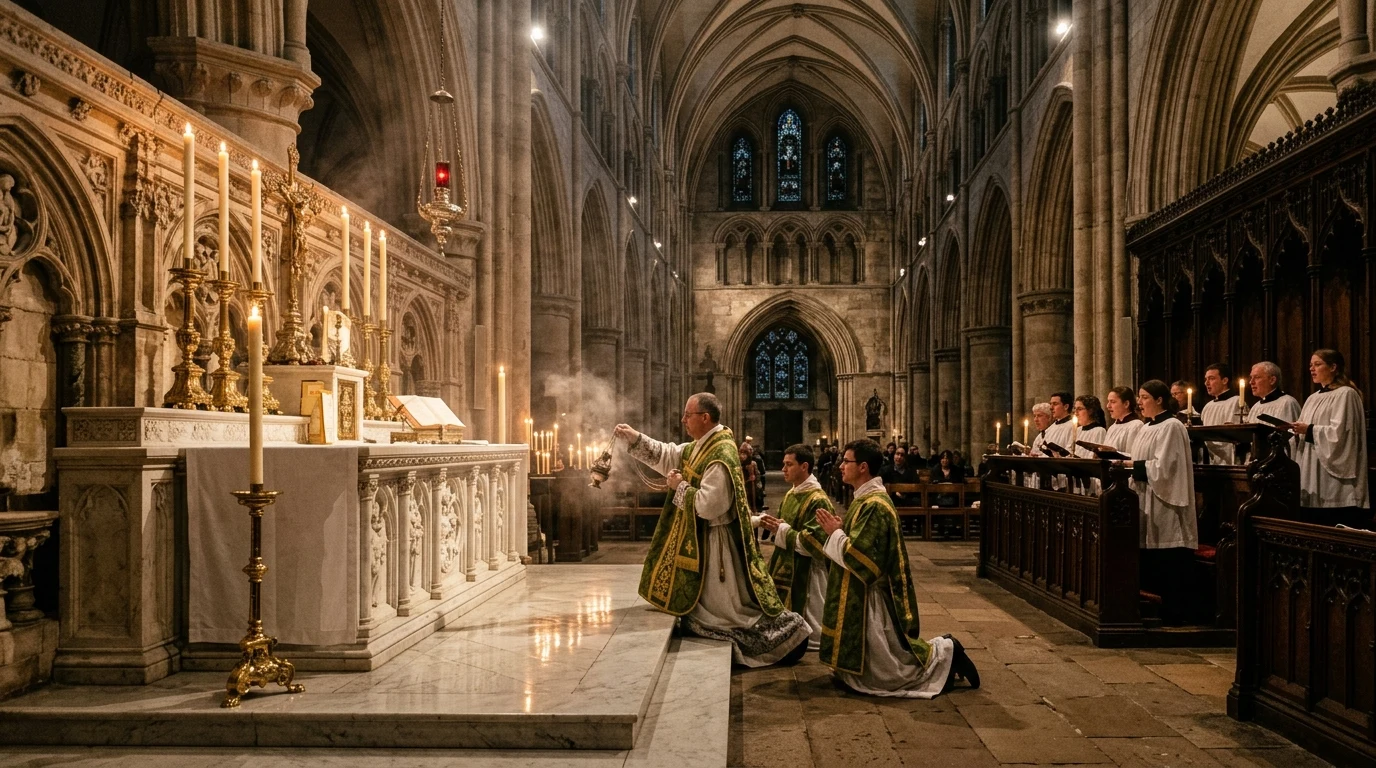
2. The Extraordinary Form (Traditional Latin Mass / Usus Antiquior)
Codified after the Council of Trent by Pope Saint Pius V in 1570 (and revised in 1962 under Pope Saint John XXIII), the Traditional Latin Mass represents the historical form celebrated for centuries. Characteristics include:
- Conducted entirely in ecclesiastical Latin, with readings translated for the homily.
- The priest and congregation face God together towards the liturgical east (ad orientem).
- A single, ancient Roman Canon (Eucharistic Prayer I) recited in a sacred whisper (canon submissa voce).
- Strict adherence to traditional postures, silent prayer, and reception of Holy Communion kneeling and on the tongue.
3. The Anglican Use (Divine Worship)
Established by Pope Benedict XVI under the Apostolic Constitution Anglicanorum Coetibus for former Anglicans entering full Catholic communion, this liturgical use preserves the noble Elizabethan English prose of the Book of Common Prayer within a valid Catholic Eucharistic canon.
Other Historic Western Liturgical Rites
While the Roman Rite became dominant, several ancient Western rites survived or were re-established across Europe:
- Ambrosian Rite: Ancient liturgy of the Archdiocese of Milan, tracing back to Saint Ambrose (4th century). It features distinctive liturgical calendar variations, unique baptismal rites, and a longer Lent beginning on the Sunday following Ash Wednesday.
- Mozarabic (Visigothic) Rite: Originating in the Iberian Peninsula (Spain and Portugal) prior to the Arab conquest, preserved in special chapels in the Cathedral of Toledo. It features nine separate scripture readings and elaborate Eucharistic prayers.
- Bragan Rite: The historical liturgical rite of the Archdiocese of Braga in northern Portugal.
- Religious Order Uses: Historic rites preserved by ancient monastic orders, most notably the Dominican Rite, Carmelite Rite, and Carthusian Rite.
Eastern Catholic Divine Liturgies: Windows to the East
The 23 Eastern Catholic Churches celebrate their own ancient Eucharistic liturgies, rich in mysticism, iconography, and poetic theology:
| Liturgical Family | Representative Churches | Primary Service Name | Liturgical Languages | Key Defining Characteristic |
|---|---|---|---|---|
| Roman / Latin | Latin Catholic Church | Holy Mass / Eucharistic Celebration | Latin, English, Spanish, global vernaculars | Clear structural logic, sobriety, and concise collects. |
| Byzantine | Ukrainian, Melkite, Ruthenian | Divine Liturgy of St. John Chrysostom | Greek, Church Slavonic, Arabic, English | Iconostasis wall, continuous chanting, threefold litanies, leavened bread. |
| West Syriac | Maronite, Syriac Catholic | Qurbono / Holy Qurbana | Syriac (Aramaic), Arabic, English | Direct linguistic ties to Jesus’s spoken Aramaic; poetic prayers. |
| East Syriac | Chaldean, Syro-Malabar | Holy Qurbana of Addai and Mari | Syriac, Malayalam, Arabic | Ancient anaphora dating to apostolic times in Mesopotamia and India. |
| Alexandrian | Coptic, Ethiopian, Eritrean | Divine Liturgy of St. Basil / St. Mark | Coptic, Ge’ez, Arabic | Rhythmic cymbals, solemn prostrations, ancient desert monastic asceticism. |
| Armenian | Armenian Catholic Church | Badarak (Holy Sacrifice) | Classical Armenian (Grabar) | Majestic choral polyphony, veiled altars, ornate domed miters. |
Ecclesial Unity in Liturgical Diversity
Can a Latin Catholic attend an Eastern Catholic Divine Liturgy, and does it fulfill their Sunday obligation? Yes. The Code of Canons of the Eastern Churches and the Code of Canon Law both affirm that any Catholic may fulfill their Sunday obligation by attending the Eucharistic liturgy celebrated in any Catholic rite.
This diversity demonstrates that Christian unity does not mean rigid uniformity. Rather, the coexistence of these diverse liturgical rites reflects the manifold beauty of God’s grace working across the nations and civilizations of the earth.
To continue exploring liturgical theology, compare these rites with our comprehensive guides on the step-by-step Catholic Mass process, the theological distinction between Mass vs. Communion, and our detailed introduction to global Christian liturgical families.
Frequently Asked Questions
How many Catholic Mass rites are there?
There are six major liturgical families comprising over twenty distinct liturgical traditions within the Catholic Church, including the Latin (Roman, Ambrosian, Mozarabic), Byzantine, West Syriac, East Syriac, Alexandrian, and Armenian rites.
Can a Roman Catholic receive Communion at an Eastern Catholic church?
Yes. Because Eastern Catholic Churches are in full communion with the Pope in Rome, any Catholic in good standing may receive the Holy Eucharist at an Eastern Catholic Divine Liturgy.
What is the difference between a rite and a Church?
A “Church” (such as the Ukrainian Greek Catholic Church or Maronite Church) is an autonomous community of believers with its own hierarchy, while a “rite” is the liturgical, theological, and spiritual tradition that Church utilizes for worship.
Is the Traditional Latin Mass still considered a valid Catholic rite?
Yes. The Traditional Latin Mass is a legitimate historical form of the Roman Rite, governed by current canonical directives from the Holy See (such as Traditionis Custodes), celebrated with the permission of the local diocesan bishop.
Get our latest guides, news, and insights highlighted in your Google Search & AI Overviews.


 THE SECRET ELITES DON'T WANT YOU TO KNOW