
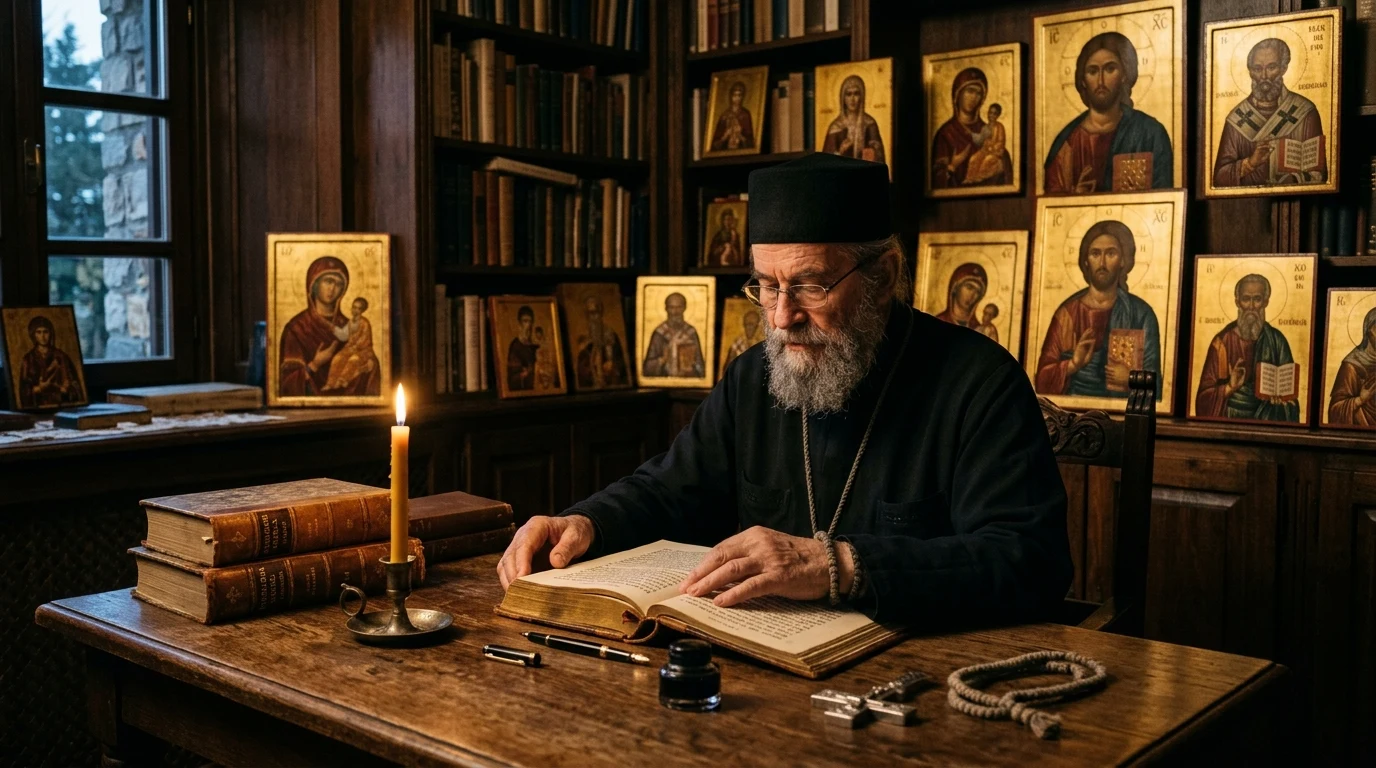
Matheus Soares de Azevedo & Orthodoxy | Western Church
✨ This article was AI edited. Editorial responsibility: WesternChurch.net.
Matheus Soares de Azevedo on Eastern Orthodoxy examines the Brazilian philosopher, essayist, and Traditionalist thinker’s extensive scholarship on Byzantine theology, the hesychast spiritual method, and the mystical continuity of Eastern Christian sacred tradition within the framework of the Philosophia Perennis.
In contemporary comparative religious philosophy, few Latin American scholars have engaged the intellectual depths of the Christian East with the rigor and spiritual fidelity of Matheus Soares de Azevedo. A prominent exponent of the Perennialist or Traditionalist school—deeply influenced by figures such as Frithjof Schuon, René Guénon, and Philip Sherrard—Azevedo has dedicated substantial portions of his literary corpus to exploring the mystical heart of the Orthodox Christian Church. His writings offer Western readers a profound bridge into hesychasm, the theology of the uncreated energies, and the contemplative patrimony preserved by the Greek, Slavic, and Middle Eastern Orthodox traditions.
Contents
Who is Matheus Soares de Azevedo?
Born in Belo Horizonte, Brazil, Matheus Soares de Azevedo is an author, journalist, translator, and historian of religions. Holding degrees in history and international relations from the University of São Paulo, he established himself as a foremost interpreter of sacred traditions in the Portuguese-speaking world. His published books, including A Inteligência da Fé (The Intelligence of Faith), O Livro dos Mestres (The Book of Masters), and Mística Islâmica e Sabedoria Oriental, consistently emphasize the transcendent unity of religious paths while upholding the unique doctrinal integrity of each historical orthodoxy.
Within this broader philosophical scope, Azevedo’s analysis of Eastern Orthodoxy holds a unique status. Rather than treating Christian theology as an abstract set of rational syllogisms, Azevedo presents Eastern Orthodoxy as a living, unbroken contemplative sanctuary that preserved the ancient ascetical methods lost or diminished in post-Enlightenment Western thought.
Core Themes in Azevedo’s Orthodox Scholarship
Azevedo’s writings identify several essential theological pillars that distinguish Eastern Orthodoxy as an indispensable custodian of ancient Christian gnosis (spiritual knowledge):
1. Hesychasm and the Prayer of the Heart
Central to Azevedo’s valuation of Orthodoxy is the hesychast tradition (from the Greek hesychia, meaning inner stillness). Tracing the lineage from the Desert Fathers through the fourteenth-century defense by Saint Gregory Palamas, Azevedo highlights the Jesus Prayer (“Lord Jesus Christ, Son of God, have mercy on me, a sinner”) as a psycho-physical discipline uniting intellect, breathing, and heart. In his comparative essays, Azevedo demonstrates how the Prayer of the Heart parallels the invocatory methods found in Islamic Sufism (dhikr) and Hindu japa, while affirming its strictly Christocentric theological nature.
2. The Palamite Distinction: Essence and Energies
Azevedo frequently expounds upon Saint Gregory Palamas’s crucial theological distinction between God’s transcendent, unknowable Essence (ousia) and His participatory, uncreated Energies (energeiai). For Azevedo, this doctrine rescues theology from both pantheism (which collapses God into the world) and deistic agnosticism (which removes God entirely from human experience). Through the divine energies, human beings are capable of true deification (theosis)—becoming “partakers of the divine nature” (2 Peter 1:4) without losing their created creaturehood.
3. Sacred Art and the Ontology of the Icon
Another major theme in Azevedo’s work is the liturgical icon. Echoing Saint John of Damascus and Theodore the Studite, Azevedo argues that Orthodox icons are not decorative human artifacts, but liturgical sacramental windows. Because God truly took human flesh in the Incarnation of Jesus Christ, material reality is sanctified, allowing wood and egg tempera pigment to mediate real spiritual grace.
Comparative Overview: Eastern Orthodoxy and Perennial Philosophy
| Philosophical Dimension | Azevedo’s Perennialist Framework | Eastern Orthodox Doctrinal Formulation | Key Theological Nexus |
|---|---|---|---|
| Ultimate Reality | The Absolute / Divine Principle beyond all conceptual forms. | The Holy Trinity: Father (fount), Son (Logos), Holy Spirit. | Apophatic theology (knowing God through unknowing / silence). |
| Spiritual Realization | Transcendent identification with the Divine Reality. | Theosis (divinization) through sanctifying grace. | Participation in the uncreated divine energies of God. |
| Meditative Practice | Invocation of the Divine Name across sacred traditions. | The Jesus Prayer practiced with inner silence (hesychia). | Rhythmic prayer of the heart under spiritual direction. |
| Ecclesiastical Continuity | Primacy of primordial Tradition transmitted through lineages. | Unbroken Apostolic Succession and Seven Ecumenical Councils. | Preservation of liturgical canons and patristic consensus. |
| Sacred Cosmology | Symbolic cosmos as a hierarchical reflection of higher realms. | Transfiguration of creation through Christ’s cosmic redemption. | Sanctification of matter through water, oil, bread, and wine. |
Azevedo’s Dialogue with Christian Traditionalists
Azevedo’s perspective on Eastern Orthodoxy aligns closely with twentieth-century Western intellectuals who converted to or championed Orthodoxy as an antidote to modern secularism. He frequently cites:
- Philip Sherrard (1922–1995): The British theologian, poet, and Mount Athos translator whose critique of Western rationalism and defense of the Greek Church profoundly shaped Azevedo’s cosmological perspective.
- Frithjof Schuon (1907–1998): Whose writings on the Christian esoteric dimension highlighted the sacramental depth of the Byzantine liturgy.
- Vladimir Lossky and Georges Florovsky: Neo-patristic scholars whose revival of the Church Fathers provided the historical backbone for contemporary traditionalist engagement with Orthodoxy.
The Lasting Impact of Azevedo’s Orthodox Reflections
For readers in the Americas, Europe, and the global South, Matheus Soares de Azevedo’s work serves as a reminder that Eastern Orthodoxy is not an archaic relic of Eastern European geography, but an active, universal wellspring of Christian contemplative wisdom. His essays urge Western Christians to rediscover their own forgotten contemplative roots by studying the ascetical literature of the Philokalia and the liturgical reverence of the Byzantine rite.
To further examine the deep historical and theological development of Christian orthodoxy, continue reading our companion studies on the foundational principles of Eastern Orthodoxy, historical medieval sanctuaries such as the 1194 Church of Saint Panteleimon, and our detailed analysis of sacramental liturgical rites.
Frequently Asked Questions
Who is Matheus Soares de Azevedo?
Matheus Soares de Azevedo is a Brazilian author, religious historian, and comparative philosopher associated with the Traditionalist (Perennialist) school of philosophy, known for his writings on Christian mysticism, Islam, and the spirituality of Eastern Orthodoxy.
What is Eastern Orthodoxy according to Traditionalist philosophy?
Traditionalist philosophers regard Eastern Orthodoxy as an authentic and unbroken repository of ancient Christian esoterism and contemplative discipline, particularly praising its preservation of hesychasm, sacred iconography, and apophatic theology.
What is hesychasm?
Hesychasm is an ancient Eastern Christian contemplative prayer tradition dating back to the fourth-century Desert Fathers, centered on achieving inner stillness and constant prayer through the disciplined repetition of the Jesus Prayer.
Did Matheus Soares de Azevedo translate theological works?
Yes. Azevedo has translated, edited, and introduced major philosophical and spiritual texts into Portuguese, including works by Frithjof Schuon, Martin Lings, and classic texts of traditional Christian and Islamic mysticism.
Get our latest guides, news, and insights highlighted in your Google Search & AI Overviews.



 PROSPERITY PRAYER