
The Diverse Rites of the Catholic Mass: Latin, Eastern, and Historical Liturgies Explained
✨ This article was AI edited. Editorial responsibility: WesternChurch.net.
The Catholic Church celebrates the Mass through multiple distinct liturgical rites across 24 autonomous sui iuris churches in full communion with the Pope, organized into six major liturgical families: Latin, Byzantine, Alexandrian, Antiochene, East Syrian, and Armenian. While the Roman Rite is the most widely celebrated form in the Western world, every recognized Catholic rite shares identical sacramental validity, professes the same dogma, and centers on the true presence of Christ in the Holy Eucharist.
Contents
The Universal Church and the Six Liturgical Families
A common misconception among contemporary observers is the assumption that Roman Catholicism is liturgically monolithic. In Catholic ecclesiology and sacramental theology, the universal Catholic communion is composed of the Latin Church (the Western patriarchate) and 23 Eastern Catholic Churches. Each of these churches preserves an ancient, legitimate liturgical inheritance rooted in the early apostolic sees of Rome, Alexandria, Antioch, Constantinople, and Edessa.
The Second Vatican Council solemnly declared in its decree Orientalium Ecclesiarum that all canonical rites within the Catholic Church are of equal dignity and right, possessing full apostolic authority. Whether celebrating the Mass in Latin, Koine Greek, Old Church Slavonic, Classical Syriac, Ge’ez, or modern vernacular tongues, every validly ordained Catholic priest effects the substantial conversion of bread and wine into the Body and Blood of Jesus Christ through the words of consecration and epiclesis.
| Liturgical Family | Major Catholic Churches | Primary Liturgies Celebrated | Traditional Language |
|---|---|---|---|
| Latin (Western) | Latin Catholic Church | Roman Rite (Ordinary/Extraordinary), Ambrosian, Mozarabic | Latin, Vernaculars |
| Byzantine | Ukrainian, Melkite, Greek, Ruthenian, Romanian | Divine Liturgy of St. John Chrysostom, St. Basil the Great | Greek, Church Slavonic, Arabic |
| Alexandrian | Coptic Catholic, Ethiopian, Eritrean Catholic | Liturgy of St. Cyril, St. Basil, Ge’ez Anaphoras | Coptic, Ge’ez, Arabic |
| Antiochene (West Syriac) | Maronite Church, Syriac Catholic, Syro-Malankara | Liturgy of St. James, Maronite Qurbono | Syriac, Arabic, Malayalam |
| East Syrian (Chaldean) | Chaldean Catholic, Syro-Malabar Catholic Church | Holy Qurbana of Addai and Mari, Theodore of Mopsuestia | Aramaic/Syriac, Arabic, Malayalam |
| Armenian | Armenian Catholic Church | Armenian Divine Liturgy of St. Gregory the Illuminator | Classical Armenian (Grabar) |
The Latin Liturgical Tradition: Forms and Regional Rites
The Latin Church represents the largest constituent body of Catholicism. Within the Western tradition, several distinct rites and usages flourish under canonical approval:
1. The Roman Rite
The central liturgical rite of the Diocese of Rome, the Roman Rite has shaped Western Christian history. Today, it exists primarily in two historical expressions:
- The Ordinary Form (Novus Ordo Missae): Promulgated by Pope Paul VI in 1969 following the Second Vatican Council, this form features an expanded three-year lectionary cycle, active congregational vocal responses, celebration typically facing the assembly (versus populum), and universal usage of approved vernacular languages alongside Latin.
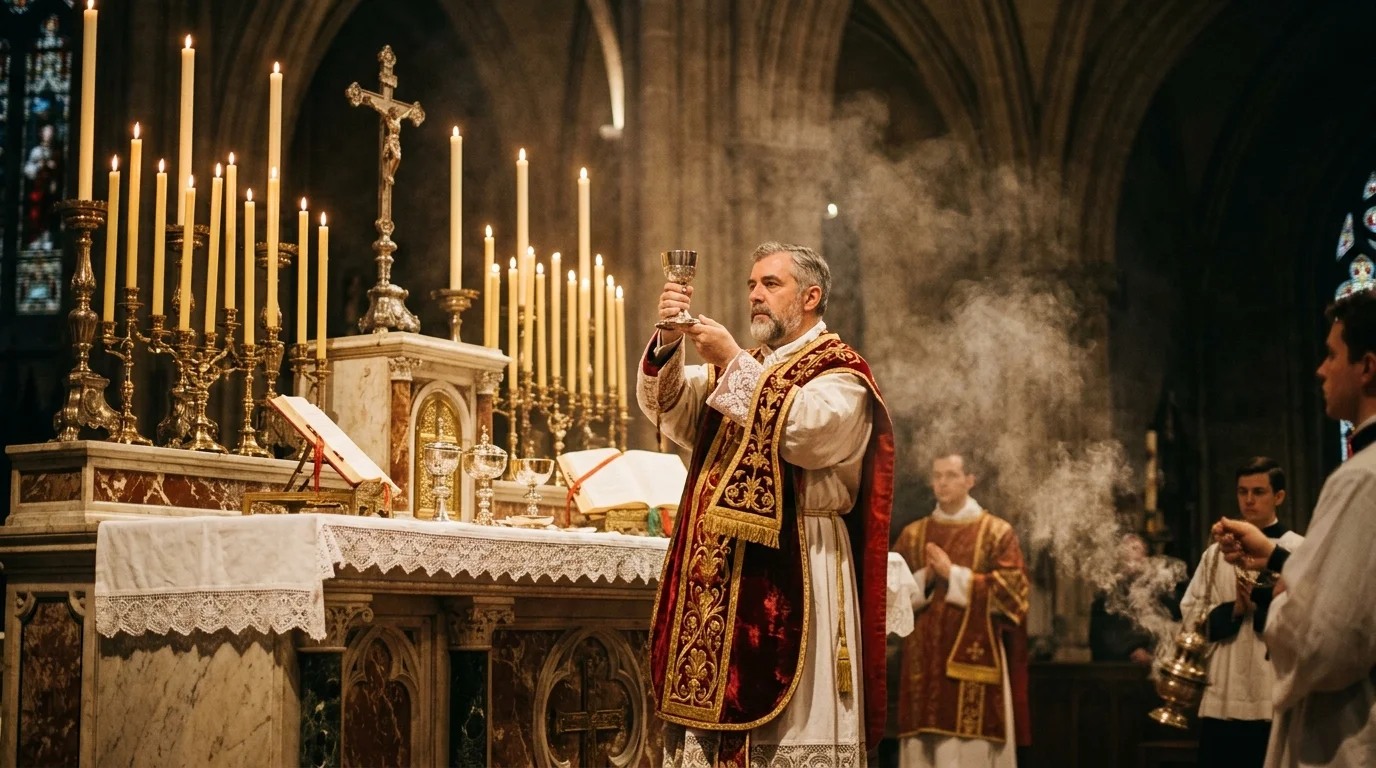
- The Extraordinary Form (Traditional Latin Mass): Governed historically by the 1962 Roman Missal promulgated by Saint John XXIII and Pope Pius V (originally codified in 1570 at the Council of Trent), this liturgical form is offered in ecclesiastical Latin, celebrated facing the high altar (ad orientem), with a one-year lectionary, extensive silent priestly prayers, and communion received exclusively kneeling and on the tongue.
- The Anglican Use (Divine Worship): Established by Pope Benedict XVI through the apostolic constitution Anglicanorum Coetibus (2009), this liturgical usage allows former Anglicans who entered full Catholic communion within Personal Ordinariates to retain traditional Tudor and Jacobean sacred English, choral psalmody, and liturgical prayers from the Book of Common Prayer harmonized with the Roman Canon.
2. Western Non-Roman Rites
Several ancient Western cities preserved distinct regional liturgical rites that survived the Post-Tridentine standardization of 1570:
- The Ambrosian Rite: Practiced in the Archdiocese of Milan and parts of Switzerland, this rite is attributed to Saint Ambrose (340–397 CE). It features a distinct liturgical calendar, a unique six-week Advent, ceremonial foot-washing, and distinct baptismal and Eucharistic rubrics.
- The Mozarabic (Hispano-Visigothic) Rite: Dating back to the 5th century in the Iberian Peninsula, this ancient Spanish rite was preserved during centuries of Islamic rule in Toledo and is celebrated daily in the Capilla Mozárabe inside the Cathedral of Toledo.
- The Bragan Rite: The historical local rite of the Archdiocese of Braga in northern Portugal, retaining medieval Portuguese sacramental customs.
Eastern Catholic Mass Rites: The Divine Liturgy and Holy Qurbana
The Eastern Catholic Churches provide an extraordinary theological and aesthetic depth to Catholic worship, offering liturgies characterized by rich visual iconography, clouds of frankincense, intricate chanted psalmody, and deep mystical contemplation:
1. The Byzantine Rite
Used by 14 of the 23 Eastern Catholic Churches (including the Ukrainian Greek Catholic Church and Melkite Greek Catholic Church), the Byzantine Rite centers on the Divine Liturgy of Saint John Chrysostom for ordinary Sundays, and the longer, more solemn Divine Liturgy of Saint Basil the Great during Great Lent and major feasts. Byzantine worship is marked by the presence of the iconostasis (icon screen) separating the nave from the sanctuary, deep metanies (prostrations), frequent litanies with the refrain “Lord, have mercy” (Kyrie eleison), and communion distributed using a golden liturgical spoon (both Body and Blood in leavened bread).
2. The West Syrian and Maronite Tradition
Originating in ancient Antioch, where the disciples were first called Christians (Acts 11:26), this liturgical family emphasizes biblical poetry, typology, and the continuous action of the Holy Spirit. The Maronite Church of Lebanon celebrates the Holy Mystery (Qurbono) utilizing ancient prayers composed in West Syriac (a dialect of Aramaic, the spoken language of Jesus Christ), marked by evocative chants and unique Eucharistic prayers (anaphoras).
3. The East Syrian and Chaldean Tradition
Preserved by the Chaldean Catholic Church of Iraq and the Syro-Malabar Catholic Church of India (founded by the Apostle Saint Thomas in 52 CE), this tradition uses the Anaphora of Apostles Addai and Mari. Addai and Mari is famous among liturgical scholars as one of the oldest continuous Eucharistic liturgies in Christendom, tracing its origins directly to the 2nd and 3rd century Mesopotamian Church.
Despite striking variations in language, liturgical vestments, ecclesiastical architecture, and ritual ceremonies, all Catholic Mass rites share three fundamental theological criteria:
- Apostolic Succession: Every presiding celebrant must be a validly ordained bishop or priest whose ministerial priesthood traces via unbroken episcopal imposition of hands back to the Twelve Apostles.
- Real Eucharistic Sacrifice: Every rite affirms that the Mass is not merely a memorial meal, but the unbloody re-presentation of Christ’s once-for-all sacrifice on Calvary, resulting in the true, real, and substantial presence of Christ’s Body, Blood, Soul, and Divinity.
- Communion with the Roman Pontiff: Each sui iuris church and its bishops operate in voluntary canonical union with the Bishop of Rome, acknowledging the Petrine primacy as the universal center of Catholic unity.
Frequently Asked Questions
How many different rites are there in the Catholic Church?
There are six major liturgical families (Latin, Byzantine, Alexandrian, Antiochene, East Syrian, and Armenian) encompassing more than twenty distinct liturgical rites and usages celebrated across 24 autonomous Catholic churches in communion with Rome.
Can a Roman Catholic attend and receive Communion at an Eastern Catholic Mass?
Yes. Under the Code of Canons of the Eastern Churches and the Latin Code of Canon Law (Canon 923 and Canon 1248 §1), any Catholic in good standing may fulfill their Sunday Mass obligation and receive Holy Communion in any Catholic rite.
What is the difference between a rite and a church sui iuris?
A church sui iuris is a self-governing community of faithful united by an ecclesiastical hierarchy and recognized by the Pope (such as the Ukrainian Catholic Church or the Maronite Church). A rite is the liturgical, theological, spiritual, and disciplinary heritage by which that church expresses its faith.
Is the Traditional Latin Mass a separate Catholic rite?
No. The Traditional Latin Mass (celebrated according to the 1962 Missale Romanum) is not a separate rite, but an earlier historical form or usage of the Roman Rite, which belongs to the Western Latin liturgical family.
Get our latest guides, news, and insights highlighted in your Google Search & AI Overviews.


 FINAL WARNING