
Catholic Mass Process — Step-by-Step Guide | Western Church
✨ This article was AI edited. Editorial responsibility: WesternChurch.net.
The Catholic Mass process is the four-part liturgical order of Roman Catholic Eucharistic worship comprising the Introductory Rites, the Liturgy of the Word, the Liturgy of the Eucharist, and the Concluding Rites, through which the gathered Church offers solemn thanksgiving and re-presents the sacrificial redemption of Jesus Christ.
Walking into a Catholic church for the Holy Sacrifice of the Mass can feel deeply majestic yet complex for newcomers, catechumens, and visitors. Every movement of the priest, every posture of the congregation (standing, sitting, kneeling), and every sung acclamation follows a time-honored spiritual sequence designed over two millennia. This detailed, step-by-step guide breaks down the full Catholic Mass process from the initial entrance procession to the final dismissal, explaining both the structural rubrics and the profound biblical symbolism behind each sacred phase.
Contents
The Four Pillars of the Sacred Liturgy
The General Instruction of the Roman Missal (GIRM) divides the Mass into two primary parts—the Liturgy of the Word and the Liturgy of the Eucharist—framed symmetrically by the Introductory Rites and Concluding Rites. Together, they form one single act of divine worship where Christ feeds His disciples first at the ambo through sacred scripture, and then at the altar through His sacramental Body and Blood.
Part I: The Introductory Rites
The purpose of the Introductory Rites is to gather the scattered faithful into a unified worshipping body, prepare their hearts through repentance, and direct their praise toward God.
1. Entrance Procession and Hymn
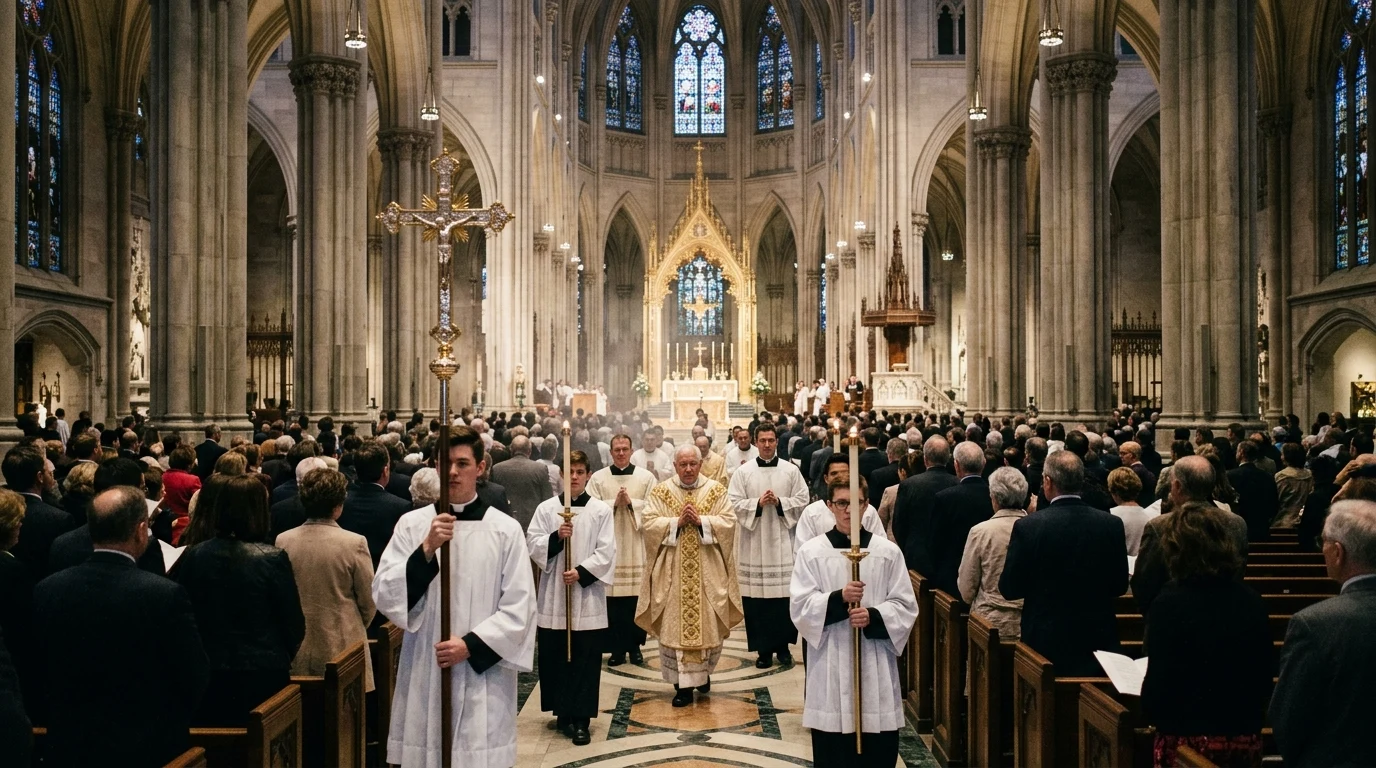
As the bell chimes, the congregation rises and sings an opening hymn. The liturgical procession moves down the central aisle toward the sanctuary, led by the thurifer (carrying burning incense, when used), altar servers bearing the processional crucifix and candles, the lector or deacon carrying the Book of the Gospels, and the celebrating priest.
2. Veneration of the Altar and Sign of the Cross
Upon reaching the sanctuary, the ministers reverence the altar with a profound bow. The priest steps up and kisses the altar stone, which contains relics of holy martyrs and represents Christ Himself, the cornerstone of the Church. The priest and congregation then make the Sign of the Cross, invoking the Holy Trinity.
3. The Penitential Act (Kyrie / Confiteor)
Acknowledging their human unworthiness before entering the divine mysteries, the congregation pauses in silent self-examination. Together, they recite the Confiteor (“I confess to almighty God…”) or join in the ancient Greek supplication: Kyrie, eleison; Christe, eleison; Kyrie, eleison (“Lord, have mercy; Christ, have mercy; Lord, have mercy”).
4. The Gloria (Glory to God)
On Sundays outside of Advent and Lent, and on solemn feasts, the joyful hymn of the angels at Bethlehem is sung or recited: “Glory to God in the highest, and on earth peace to people of good will.”
5. The Collect (Opening Prayer)
The priest says, “Let us pray,” and pauses so that the congregation can offer their personal intentions. He then chants or recites the Collect, a formal liturgical petition that gathers the prayers of the faithful into a focused theological theme reflecting the liturgical season or feast day.
Part II: The Liturgy of the Word
In this second phase, the congregation sits to listen attentively to God speaking through the scriptures, standing in honor of the Holy Gospel.
1. First Reading
A trained lector proclaims the First Reading from the Old Testament (or from the Acts of the Apostles during Eastertide), highlighting the promises and covenants of God that find their fulfillment in Christ.
2. Responsorial Psalm
The psalmist or cantor leads the singing of a biblical psalm from the Book of Psalms, with the congregation responding with an inspired refrain that meditates on the theme of the First Reading.
3. Second Reading (Epistle)
On Sundays and solemnities, a second lector reads from the New Testament Epistles (letters of Paul, Peter, John, or James) or the Book of Revelation, offering practical instruction for Christian discipleship.
4. Gospel Acclamation and Holy Gospel
The assembly stands to sing the Alleluia (replaced by a solemn praise acclamation during Lent). The deacon or priest traces the Sign of the Cross on the Book of the Gospels and on his forehead, lips, and breast—a gesture mirrored by the faithful, praying that the Word of God may be in their minds, on their lips, and in their hearts. The priest then proclaims the Holy Gospel, recounting the life, miracles, and teachings of Jesus.
5. The Homily
The priest or deacon delivers a sermon reflecting upon the readings, breaking open the Word and connecting scripture to the spiritual and ethical dilemmas of daily life.
6. Profession of Faith (The Creed)
Standing together, the assembly recites the Nicene or Apostles’ Creed, articulating the foundational doctrines of the Catholic faith passed down from the early Church councils.
7. Universal Prayer (Prayers of the Faithful)
The congregation petitions God for the needs of the universal Church, public leaders, the suffering, the local parish, and the souls of the faithful departed.
Part III: The Liturgy of the Eucharist
This is the spiritual center and pinnacle of the Mass, mirroring the Last Supper of Christ.
1. Preparation of the Altar and Presentation of the Gifts
Representatives of the parish bring bread, wine, water, and financial tithes to the altar. The priest offers prayers blessing God for the bread and wine, mingling a droplet of water into the wine chalice—symbolizing Christ’s divinity uniting with human nature.
2. The Eucharistic Prayer
The congregation kneels (or stands, in certain national customs) as the priest enters the most sacred prayer of the liturgy:
- Preface Dialogue & Sanctus: The singing of “Holy, Holy, Holy Lord God of hosts” (Sanctus).
- Epiclesis: The priest extends his hands over the offerings, invoking the Holy Spirit to transform the bread and wine.
- Institution Narrative and Consecration: Repeating Christ’s exact words from the Last Supper (“Take this, all of you, and eat of it: for this is my Body…”), transubstantiation occurs. The priest genuflects and elevates the Host and Chalice for the adoration of the faithful as bells are rung.
- Memorial Acclamation & Doxology: Proclaiming the mystery of faith (“We proclaim your Death, O Lord, and profess your Resurrection until you come again”), culminating in the Great Amen.
3. The Communion Rite
The assembly stands to pray the Lord’s Prayer (Our Father), exchanges a mutual Sign of Peace, and recites the Agnus Dei (“Lamb of God, who takes away the sins of the world, have mercy on us”). Communicants approach reverently to receive the sacrament, returning to their pews for silent prayer and contemplation.
Part IV: The Concluding Rites
Having received the spiritual nourishment of Christ’s Word and Sacrament, the assembly prepares to return to the world.
- Post-Communion Prayer: The priest leads a final prayer of gratitude.
- Final Blessing: The priest invokes the blessing of God the Father, Son, and Holy Spirit.
- Dismissal: The deacon or priest announces the formal dismissal: “Go in peace, glorifying the Lord by your life.” The congregation responds: “Thanks be to God.”
- Recessional: The ministers reverence the altar and process out to an uplifting closing hymn.
Quick Reference: The Catholic Mass Sequence Matrix
| Phase | Key Elements | Usual Congregation Posture | Spiritual Objective |
|---|---|---|---|
| Introductory Rites | Procession, Sign of the Cross, Kyrie, Gloria, Collect | Standing | Gathering, humility, and praise. |
| Liturgy of the Word | Old Testament, Psalm, Epistle, Gospel, Homily, Creed | Sitting (standing for Gospel and Creed) | Instruction, reflection, and affirmation of faith. |
| Liturgy of the Eucharist | Offertory, Consecration, Elevation, Communion | Kneeling (standing for Our Father and line) | Sacrificial offering, adoration, and sacramental union. |
| Concluding Rites | Announcements, Final Blessing, Dismissal, Recessional | Standing | Missionary sending forth into daily life. |
Guidance for First-Time Attendees and Seekers
If you are attending Mass for the first time, don’t worry about memorizing every prayer or gesture immediately. Follow the lead of those around you when standing or sitting. When the congregation proceeds forward for Holy Communion, non-Catholics and those not yet prepared to receive may remain seated in prayer or join the line with their arms crossed across their chest to receive an individual pastoral blessing.
To dive deeper into sacramental theology and comparative Christian rites, read our foundational guides on Mass vs. Communion theology, the history of canonical vespers liturgies, and global Orthodox and Western traditions.
Frequently Asked Questions
How long does a Catholic Mass typically last?
A standard Sunday Catholic Mass usually lasts between 45 and 65 minutes. Weekday daily Masses are typically shorter (25 to 35 minutes), while solemn Easter Vigil or Christmas celebrations can extend to 90 minutes or more.
Why do Catholics stand, sit, and kneel during Mass?
Each physical posture communicates a specific spiritual attitude: standing expresses active readiness and reverence before God; sitting signifies attentive listening and contemplation during the readings; kneeling conveys humble adoration and penitence before the real presence of Christ in the Eucharist.
What should I wear to a Catholic Mass?
Modest, respectful attire is customary. While formal business clothing is not required, clean and dignified casual clothing that reflects the reverence of entering a consecrated sanctuary is encouraged.
Can non-Catholics participate in the Catholic Mass?
Yes. Everyone is welcome to attend and join in the singing, readings, and prayers of the Mass. Non-Catholics are simply asked to refrain from consuming the consecrated Eucharistic elements until they have completed formal instruction and entered into full communion with the Church.
Get our latest guides, news, and insights highlighted in your Google Search & AI Overviews.


 URGENT: THIS PAGE COULD DISAPPEAR!