
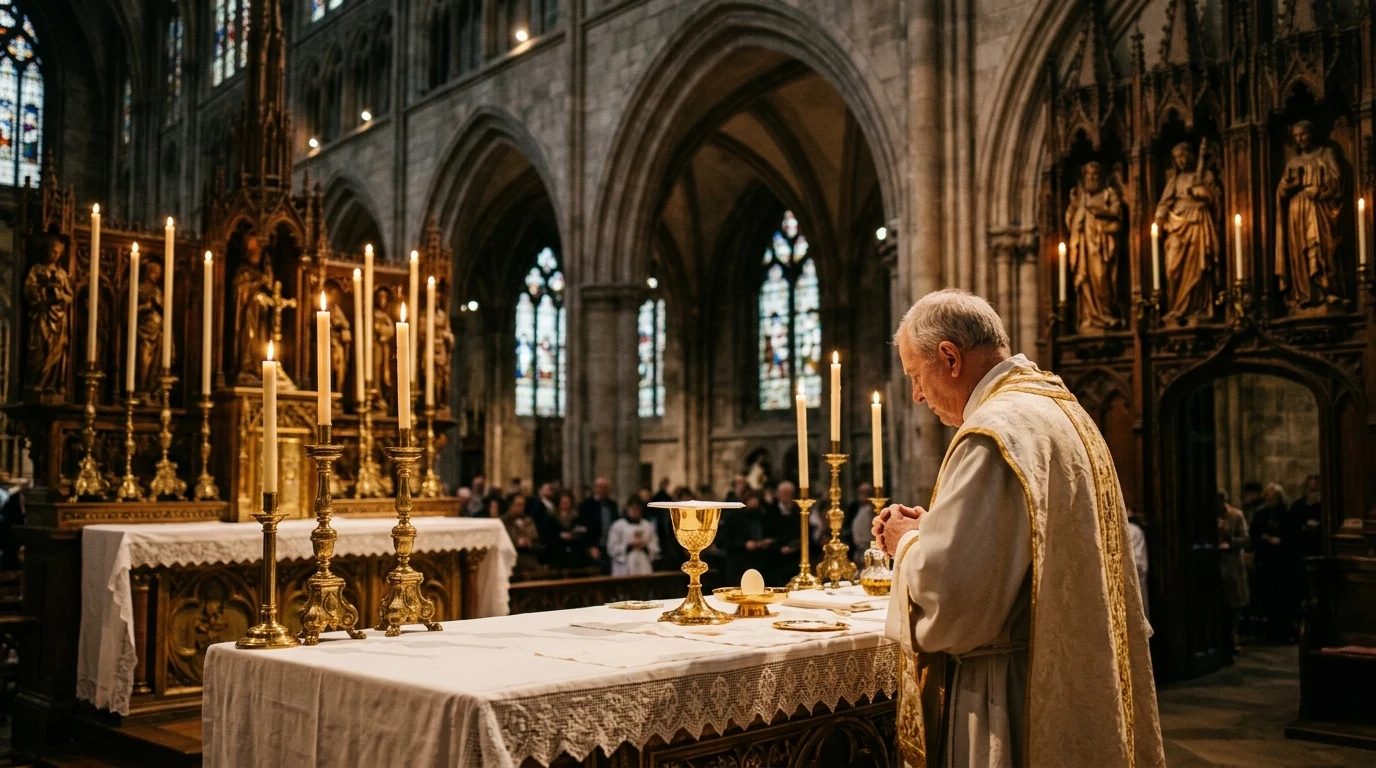
Mass vs Communion — Key Differences & Meaning | Western Church
✨ This article was AI edited. Editorial responsibility: WesternChurch.net.
The primary difference in mass vs communion is that the Mass is the complete liturgical service and public Eucharistic worship of the Church, whereas Holy Communion (the Eucharist) is the specific sacrament administered within the Mass where believers receive the consecrated Body and Blood of Jesus Christ.
For centuries, seekers, catechumens, and Christians crossing denominational lines have asked: What is the difference between Mass and Communion? While casual conversations often treat the two terms as interchangeable, Christian theology, canon law, and historical liturgy draw a clear distinction between the full liturgical assembly and the sacramental climax celebrated within it. Understanding the theological dynamics of Mass versus Communion illuminates the deep scriptural foundations, sacrificial theology, and pastoral traditions that shape Western Christianity.
Contents
- Defining the Holy Mass: The Complete Liturgical Action
- Defining Holy Communion: The Sacrament of the Lord’s Body and Blood
- Theological Distinctions: Mass vs. Communion
- Detailed Comparison: Mass vs. Holy Communion
- Ecumenical Perspectives Across Denominational Traditions
- Spiritual Readiness and Guidelines for Receiving Communion
- Frequently Asked Questions
Defining the Holy Mass: The Complete Liturgical Action
In Catholic, Anglo-Catholic, and traditional Western liturgies, the Mass (derived from the Latin concluding dismissal Ite, missa est, meaning “Go, you are sent forth”) refers to the entire ceremonial and communal liturgy. The Mass is not merely a single prayer or symbolic meal; it is a structured, four-part ritual drama designed to re-present the eternal sacrifice of Christ on Calvary in an unbloody, sacramental manner.
The Mass consists of two primary pillars flanked by introductory and concluding rites:
- Introductory Rites: The Entrance Hymn, Sign of the Cross, Penitential Act (Confiteor or Kyrie), Gloria, and Collect (Opening Prayer).
- Liturgy of the Word: First Reading (Old Testament or Acts), Responsorial Psalm, Second Reading (New Testament Epistles), Gospel Acclamation, Proclamation of the Holy Gospel, Homily, Profession of Faith (Nicene Creed), and Universal Prayer (Petitions).
- Liturgy of the Eucharist: Offertory and Preparation of the Gifts, Eucharistic Prayer with Preface and Sanctus, Epiclesis (calling of the Holy Spirit), Words of Consecration, Anamnesis, Great Amen, The Lord’s Prayer (Pater Noster), Sign of Peace, and Agnus Dei (Lamb of God).
- Concluding Rites: Final Blessing, Dismissal, and Recessional.
Defining Holy Communion: The Sacrament of the Lord’s Body and Blood
Holy Communion—also known as the Holy Eucharist, the Blessed Sacrament, the Lord’s Supper, or the Holy Mysteries—is the sacrament instituted by Jesus Christ at the Last Supper on Holy Thursday. It is the specific liturgical act where the consecrated bread and wine, transformed into the true Body and Blood of Christ through transubstantiation in Catholic doctrine, are distributed to and consumed by the faithful.
While the Mass is the solemn framework and sacrificial setting, Holy Communion is the summit toward which the liturgy ascends. Crucially, a baptized Christian can receive Holy Communion outside of a full Mass under specific pastoral circumstances, such as when an extraordinary minister or priest brings the Viaticum or Communion to the sick and homebound.
Theological Distinctions: Mass vs. Communion
To grasp the profound depth of both concepts, theologians analyze the distinction across four primary categories: liturgical scope, sacrificial character, ministerial necessity, and sacramental reception.
1. Liturgical Scope: The Whole vs. The Part
The relationship between Mass and Communion is that of a whole to its constituent summit. You cannot celebrate a Mass without celebrating the Eucharist, but Holy Communion can be distributed from the Tabernacle outside the context of a Mass. Every Mass contains Communion, but the Mass also includes the proclamation of scripture, the collective intercessions of the Church, and the priest’s offering of the Eucharistic sacrifice to God the Father.
2. The Concept of Sacrifice: Anamnesis and Offering
The Mass emphasizes the Holy Sacrifice. In the theology of Saint Thomas Aquinas and the Council of Trent, the Mass is a true propitiatory sacrifice in which Christ offers Himself to the Father through the ministry of the validly ordained priest. Communion, on the other hand, is the receptive and banquet dimension: the faithful partake in the fruits of that once-for-all sacrifice, becoming united with the Lord and with one another in the Mystical Body of Christ.
3. Ordination and Celebrant Requirements
Only an ordained priest or bishop possessing valid apostolic succession can celebrate the Holy Mass and consecrate the Eucharist. A deacon or trained lay Eucharistic minister cannot celebrate Mass. However, in the absence of a priest, deacons and authorized lay ministers can lead a “Liturgy of the Word with Holy Communion” or bring pre-consecrated hosts from the Tabernacle to hospital patients, nursing home residents, and shut-ins.
Detailed Comparison: Mass vs. Holy Communion
| Dimension | Holy Mass | Holy Communion |
|---|---|---|
| Definition | The complete communal liturgy and public Eucharistic offering of the Church. | The specific sacrament of receiving the consecrated Body and Blood of Christ. |
| Biblical Origin | The continuous apostolic worship combining the Synagogue service with the Lord’s Supper. | Christ’s words and actions at the Last Supper (“Take, eat; this is my body”). |
| Celebrant / Minister | Exclusively an ordained Priest or Bishop. | Distributed by Priests, Deacons, or appointed Extraordinary Ministers. |
| Structural Components | Liturgy of the Word, Eucharistic Prayer, Offertory, Consecration, Communion, Dismissal. | Rite of peace, fraction of bread, reception of host and chalice, silent thanksgiving. |
| Duration | Typically 45 to 75 minutes. | Typically 5 to 10 minutes within the Mass, or brief bedside distribution. |
| Standalone Ability | Cannot exist without Eucharistic consecration. | Can be administered to the sick or during Good Friday services without a full Mass. |
| Ecumenical Terminology | Divine Liturgy (Orthodox), Holy Eucharist (Anglican/Episcopalian), Divine Service (Lutheran). | The Lord’s Supper, Holy Communion, Eucharist, Holy Mysteries, Breaking of Bread. |
Ecumenical Perspectives Across Denominational Traditions
Different Christian communions view the dynamic between the liturgical service and the communion meal through distinct theological lenses:
- Eastern Orthodoxy: The service is called the Divine Liturgy (most commonly of Saint John Chrysostom or Saint Basil the Great). The sacrament is termed the Holy Mysteries, emphasizing the real presence and the transforming work of the Holy Spirit (Epiklesis) rather than Western scholastic definitions.
- Anglicanism / Episcopalianism: The Book of Common Prayer designates the rite as “The Order for the Administration of the Lord’s Supper or Holy Communion,” often referred to in modern parish usage simply as the Holy Eucharist or Mass.
- Lutheranism: The service is designated the Divine Service (Gottesdienst). Lutherans affirm the Sacramental Union—that Christ’s true body and blood are present “in, with, and under” the bread and wine.
- Reformed and Evangelical Traditions: Worship consists of song, prayer, and expository sermon. The Lord’s Supper is celebrated periodically (monthly or quarterly) primarily as an ordinance and commemorative memorial of Christ’s death.
Spiritual Readiness and Guidelines for Receiving Communion
Because Holy Communion is regarded in historic Catholic and Orthodox doctrine as the real presence of Jesus Christ, spiritual preparation is required prior to reception. In the Catholic tradition, communicants must:
- Be in a state of grace (free from unconfessed mortal sin, having received the Sacrament of Reconciliation if necessary).
- Observe the Eucharistic fast (abstaining from food and drink, except water and medicine, for at least one hour before reception).
- Hold the Catholic faith and share full ecclesial communion with the Church.
Those not receiving the elements—such as visitors of other faiths or Christians not yet in full communion—are invited to participate fully in the prayers, readings, and hymns of the Mass, or approach the priest with arms crossed over the chest to receive an individual priestly blessing.
To further examine the deep historical and theological development of sacred Christian worship across the centuries, explore our companion resources on the foundations of Christian liturgy, the canonical hours and Latin vespers, and the architectural history of historic parish churches.
Frequently Asked Questions
Is going to Communion the same as going to Mass?
No. Going to Mass means participating in the entire public liturgy of the Church, including the readings, prayers, homily, and Eucharistic sacrifice. Receiving Communion is the personal sacramental reception of the consecrated Host that occurs near the conclusion of that liturgy.
Can you attend Mass without receiving Holy Communion?
Yes. Many attendees participate fully in the Mass without receiving Holy Communion. Whether observing a fast, preparing through the Sacrament of Penance, or visiting from another religious tradition, everyone present participates in the communal prayer and receives the spiritual benefits of the holy sacrifice.
Can Communion be received outside of Mass?
Yes. The Church provides specific rites for distributing Holy Communion to the sick, dying (as Viaticum), and imprisoned outside of Mass, drawing pre-consecrated hosts from the church tabernacle.
Why do Catholics refer to the service as “Mass”?
The word “Mass” comes from the historical Latin dismissal recited at the close of the liturgy: Ite, missa est, which translates as “Go, you are sent.” It reminds the faithful that having been nourished by the Word of God and the Holy Eucharist, they are sent on a mission to live out the Gospel in the world.
Get our latest guides, news, and insights highlighted in your Google Search & AI Overviews.


 FINAL WARNING