
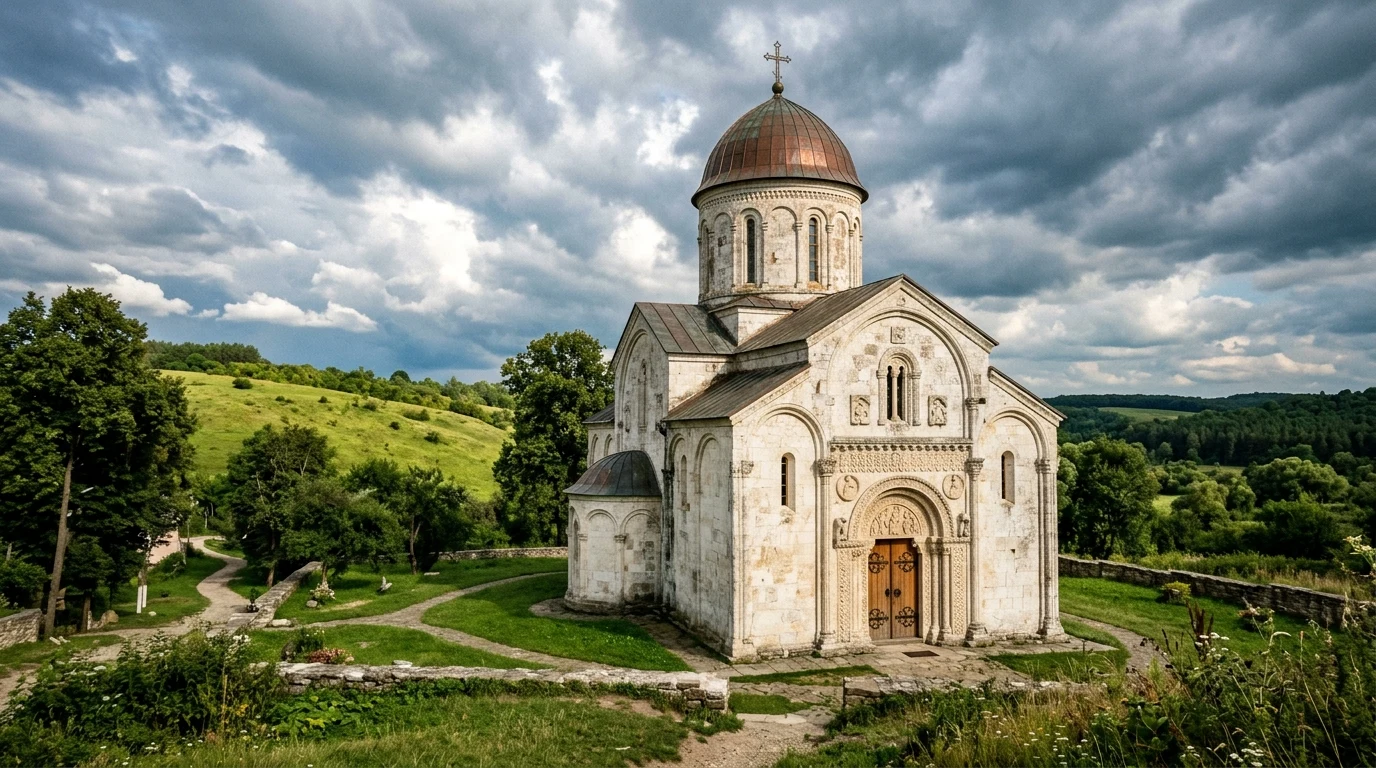
1194 Pantelimon Church in Ukraine — History | Western Church
✨ This article was AI edited. Editorial responsibility: WesternChurch.net.
Historical and architectural evidence confirms that the 1194 Church of Saint Panteleimon in Ukraine was not originally an Armenian church, but was founded around 1194 by Prince Roman Mstyslavych of the Galician-Volhynian Principality as a monumental Orthodox sanctuary, later utilized by Franciscan and Armenian Catholic communities during Polish rule.
Among the rare surviving monuments of pre-Mongol Kievan Rus’, the Church of Saint Panteleimon (Ukrainian: Церква Святого Пантелеймона), located in the village of Shevchenkove near ancient Halych in western Ukraine, occupies a place of exceptional prestige. Dating to approximately 1194, it is the only monumental white-stone church of the medieval Galician-Volhynian Principality that has survived into the modern era. However, a persistent historical question frequently arises among travelers, art historians, and ecclesiastical scholars: Was the 1194 Pantelimon Church in Ukraine an Armenian church?
Examining this intriguing inquiry requires disentangling the original twelfth-century dynastic foundations of the church from its complex later history under the Polish-Lithuanian Commonwealth, where its Romanesque stonework, western portals, and multicultural graffiti led to multiple reinterpretations of its ethnic and denominational origins.
Contents
Origins: Prince Roman Mstyslavych and the 1194 Foundation
The historical chronicle evidence and archaeological excavations directed by art historians, including Bohdan Tovstyi and Vladimir Sichynsky, firmly establish that the Church of Saint Panteleimon was founded by Prince Roman Mstyslavych (r. 1188–1205), ruler of Volodymyr-Volynskyi and founder of the unified Principality of Galicia-Volhynia. Roman named the church in honor of his Christian patron saint, Saint Panteleimon (also known in his baptismal name), establishing it as a princely votive church and monastic center.
The church was consecrated under the jurisdiction of the Orthodox Metropolitanate of Kiev and All Rus’. During the golden age of medieval Halych, it served as a spiritual fortress guarding the approaches to the princely capital along the Dniester River.
Why Did People Think the Church Was Armenian?
The hypothesis or popular confusion that the 1194 Church of Saint Panteleimon was Armenian originates from three distinct historical and architectural realities:
1. Unique Romanesque Architectural Elements
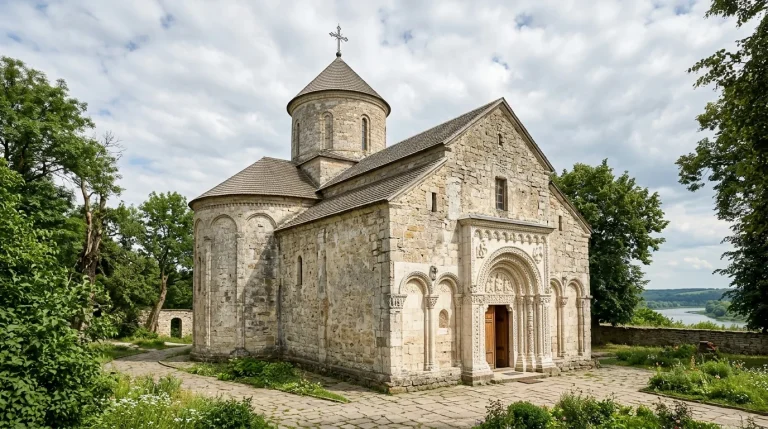
Unlike contemporary Kievan churches constructed of thin Byzantine brick (plinthite), Saint Panteleimon was constructed entirely of precision-cut white limestone ashlar blocks. Its entrance features a magnificent, recessed perspective portal adorned with carved floral capitals, acanthus leaves, and round-arched Romanesque mouldings. Because medieval Armenian architecture (such as the cathedrals of Ani and Zvartnots) is also globally renowned for exquisite white and tuff stone ashlar masonry and carved relief portals, early nineteenth-century antiquarians speculated on potential Caucasian or Armenian master masons traveling along Silk Road trade routes into Galicia.
2. The Thriving Medieval Armenian Diaspora in Halych
Beginning in the thirteenth century and expanding after the fall of the Bagratid capital of Ani to the Seljuk Turks, tens of thousands of Armenians migrated westward into Crimea, Galicia, and Poland. Halych, Lviv, and Kamianets-Podilskyi became major centers of Armenian merchant life, craft gilds, and church architecture. In the late sixteenth and seventeenth centuries, the Armenian community in Halych established their own parishes and cemetery grounds in the vicinity of ancient princely sites, creating overlapping local folklore.
3. The Roman Catholic Conversion to St. Stanislaus
In the fourteenth century, following the incorporation of Galicia into the Kingdom of Poland under King Casimir III the Great, the Orthodox monastery fell into decline. In 1595, the church was transferred to the Roman Catholic Order of Friars Minor Conventual (Franciscans), who rededicated the sanctuary to Saint Stanislaus of Szczepanów. The Franciscans added Baroque buttresses, a bell tower, and a monastery complex. This multi-century shift between Orthodox, Catholic, and multicultural usage obscured its original 1194 dynastic Rus’ identity until comprehensive twentieth-century restoration peeled back later plaster to reveal its twelfth-century limestone walls.
Epigraphic Proof: The Medieval Slavic Graffiti
The definitive historical proof settling the question of the church’s ethnic and liturgical origin came from the discovery and decipherment of over 800 historical graffiti inscriptions scratched into the soft limestone blocks of the interior and exterior walls. Published in comprehensive studies by Ukrainian historian and epigrapher Vitaliy Korniyenko:
- The inscriptions, dating between the late twelfth and seventeenth centuries, are composed in the Old East Slavic (Ruthenian) language using the Cyrillic alphabet.
- Prominent among them is a famous inscription dating to the year 1212 recording the official death of a Galician nobleman and mentioning Prince Roman by name.
- While later centuries saw Latin, Polish, and occasional merchant marks incised into the stone, there are no primary foundation inscriptions in Armenian script.
Chronological Timeline: 1194 to the Present Day
| Time Period | Historical Event / Jurisdictional Phase | Liturgical Rite / Denomination | Key Structural Change |
|---|---|---|---|
| c. 1194 | Founded by Prince Roman Mstyslavych as a royal votive sanctuary. | Eastern Orthodox (Ecumenical Patriarchate) | Cross-in-square four-pillared limestone ashlar cathedral with Romanesque portal. |
| 1240–1349 | Mongol invasions devastate Kiev; church survives as a fortified refuge. | Eastern Orthodox (Galician Eparchy) | Fortified enclosure walls and monastic cells established. |
| 1595–1772 | Granted by Polish Crown to the Franciscan Conventuals. | Roman Catholic (Latin Rite, St. Stanislaus) | Baroque vaulted renovations, buttresses, and adjoining monastery cloister. |
| 1915–1918 | Heavy artillery damage during World War I Brusilov Offensive. | Secular / Damaged | Extensive shellfire damage to western portal and upper masonry. |
| 1998 | Restoration to original 12th-century Galician-Romanesque form. | Ukrainian Greek Catholic Church (UGCC) | Dismantling of non-historic additions; reconsecration under St. Panteleimon. |
Architectural Significance: Romanesque-Byzantine Fusion
The Church of Saint Panteleimon represents a rare and breathtaking architectural synthesis. On the interior, the floor plan is purely Byzantine: a classic Greek cross-in-square (cross-domed) layout supported by four massive square pillars with three semi-circular eastern apses. On the exterior, however, the construction method, perspective portals, and relief carvings are thoroughly Western European Romanesque, likely executed by artisan stonemasons trained in the workshops of the Holy Roman Empire (Hungary, Poland, or the Rhineland).
This harmonious fusion reflects the cosmopolitan nature of the Galician-Volhynian Principality, which maintained active diplomatic, marriage, and trade alliances with both the Byzantine Empire in Constantinople and the Catholic crowns of Western Europe.
For students of medieval Christian architecture and Eastern ecclesiastical history, the Church of Saint Panteleimon remains an irreplaceable crown jewel. To expand your knowledge of related medieval Christian traditions, read our companion guides on the principles of Eastern Orthodoxy, historical analysis of ancient Galician sanctuaries, and the taxonomy of Western and Eastern Christian rites.
Frequently Asked Questions
Was the 1194 Church of Saint Panteleimon built by Armenians?
No. The Church of Saint Panteleimon in Shevchenkove (Halych) was built around 1194 by Prince Roman Mstyslavych of Galicia-Volhynia as an Orthodox church. While Halych had an active Armenian merchant community in later centuries, the original church was founded by Slavic princely patrons and masons.
Where is the Church of Saint Panteleimon located?
The church is located in the village of Shevchenkove, approximately 4 kilometers from the town of Halych in the Ivano-Frankivsk Oblast of western Ukraine, overlooking the Lukva River.
What architectural style is the Church of Saint Panteleimon?
The church is built in a distinctive Galician Romanesque-Byzantine hybrid style, combining a traditional Byzantine cross-domed interior with Western Romanesque white limestone ashlar masonry and carved perspective portals.
What is the status of the church today?
Today, the Church of Saint Panteleimon is an active consecrated place of worship belonging to the Ukrainian Greek Catholic Church and forms a central protected monument within the National Reserve “Ancient Halych.”
Get our latest guides, news, and insights highlighted in your Google Search & AI Overviews.





 PROSPERITY PRAYER