
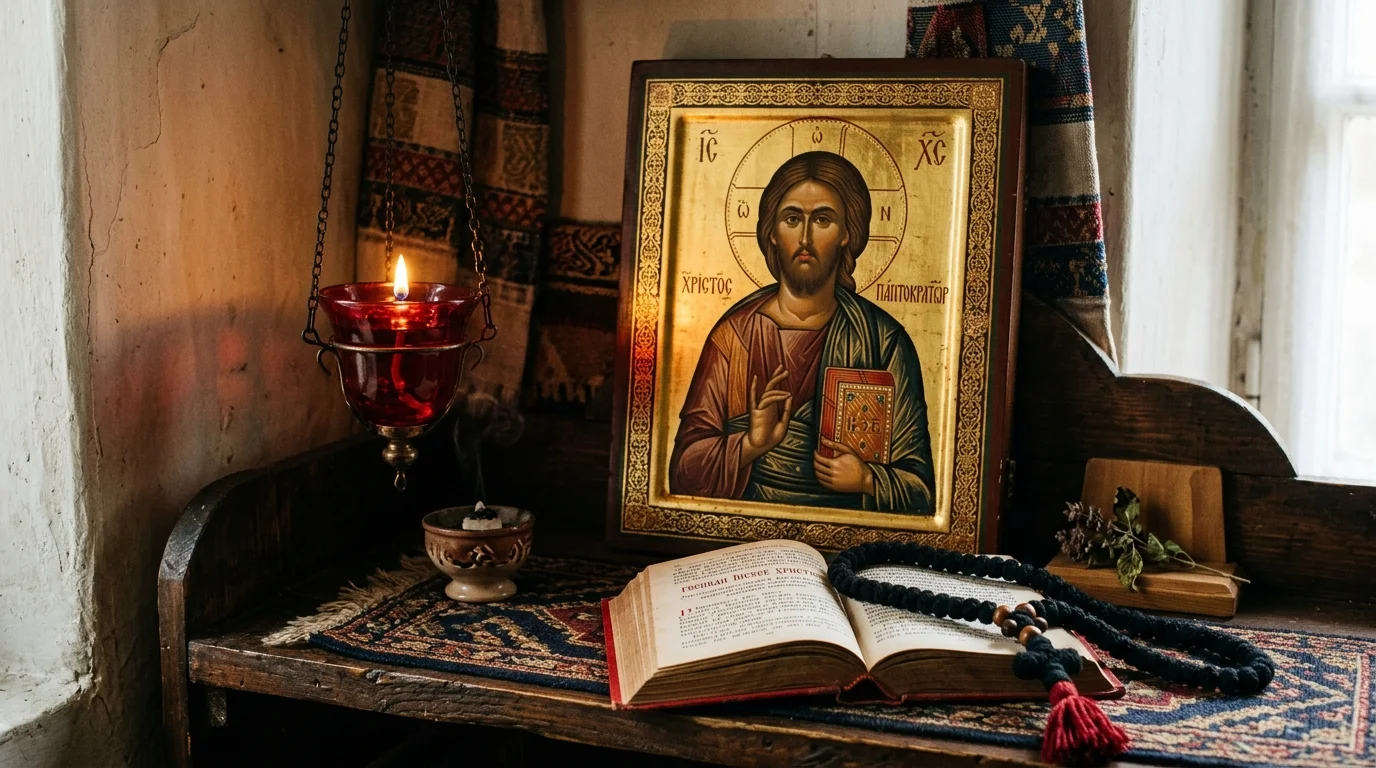
Foundations of Orthodox Theological Practice: Theosis, Liturgical Mysticism, and Patristic Tradition
✨ This article was AI edited. Editorial responsibility: WesternChurch.net.
The foundations of Orthodox theological practice rest on the inseparable unity of dogma and prayer—encapsulated in the patristic axiom lex orandi, lex credendi (the rule of prayer is the rule of faith)—oriented toward theosis (deification), the experiential transformation of human beings into partakers of the divine nature through God’s uncreated energies. Rather than treating theology as an abstract academic discipline, Eastern Orthodoxy defines a true theologian not merely as a scholar of texts, but as one who prays in purity of heart, participating directly in the sacramental and liturgical life of the Church.
Contents
- Theology as Experiential Encounter: Lex Orandi, Lex Credendi
- 1. The Doctrine of Theosis: The Goal of Human Existence
- 2. The Essence-Energies Distinction: Saint Gregory Palamas
- 3. Apophatic Humility: The Way of Negation
- 4. Ascetic Practice, Hesychasm, and the Jesus Prayer
- 5. Liturgical Realism and the Veneration of Holy Icons
- Frequently Asked Questions
Theology as Experiential Encounter: Lex Orandi, Lex Credendi
In Eastern Orthodox Christian thought, theology cannot be divorced from spiritual life, ascetic discipline, and corporate liturgical worship. As the 4th-century desert father Evagrius of Pontus famously wrote in his Chapters on Prayer, “If you are a theologian, you will pray truly; and if you pray truly, you are a theologian.”
Orthodox theological practice rejects the modern Western bifurcation between academic scholasticism and personal piety. True theology is acquired in the Divine Liturgy, through the holy mysteries (sacraments), in the silence of the Jesus Prayer, and under the illumination of the Holy Spirit. Dogmas formulated by the Seven Ecumenical Councils are not speculative philosophical propositions, but boundary markers safeguarding the historical reality of the Incarnation and the possibility of human salvation.
| Foundational Pillar | Patristic Formulation | Practical Spiritual Application | Key Scriptural & Conciliar Anchor |
|---|---|---|---|
| Theosis (Deification) | “God became man so that man might become god” (St. Athanasius) | Transfiguration of the believer through uncreated grace and virtue | 2 Peter 1:4; Psalm 82:6; John 10:34 |
| Essence-Energies Distinction | God is unknowable in His divine essence, but fully knowable in His energies (St. Gregory Palamas) | Real mystical participation in divine life without pantheistic absorption | Hesychast Councils of Constantinople (1341, 1351) |
| Apophatic Theology | Knowing God through unknowing and sacred mystery (Pseudo-Dionysius) | Humility before divine transcendence; silence (hesychia) in prayer | Exodus 20:21; 1 Timothy 6:16 |
| Hesychasm & Watchfulness | The practice of inner stillness and guard of the heart (nepsis) | Continuous unceasing recitation of the Jesus Prayer using prayer ropes | 1 Thessalonians 5:17; The Philokalia |
| Holy Icons & Incarnation | The icon affirms that the invisible Word truly took material flesh (St. John of Damascus) | Veneration of holy icons in church and the home icon corner (krasny ugol) | Seventh Ecumenical Council (Nicaea II, 787 CE) |
| Sacramental Mysticism | The Divine Liturgy as the uncreated eternal kingdom on earth | Frequent participation in Confession and the Holy Eucharist | Divine Liturgy of St. John Chrysostom; John 6:53–56 |
1. The Doctrine of Theosis: The Goal of Human Existence
At the center of Orthodox anthropology and soteriology is theosis—the understanding that salvation is not merely a legal acquittal of guilt or forensic declaration of righteousness, but a profound, ontological healing and deification of human nature. Formulated definitively by Saint Irenaeus of Lyons and Saint Athanasius the Great, the principle states that Jesus Christ assumed full humanity so that human beings might partake of the divine life.
Crucially, Orthodoxy maintains that humanity is deified by grace, not by nature. A human being never becomes God in the divine essence; rather, believers participate in God’s uncreated divine energies—His eternal light, love, wisdom, and life—retaining their individual human identity while being permeated by divine glory, like an iron poker glowing red-hot in a blacksmith’s fire.
2. The Essence-Energies Distinction: Saint Gregory Palamas
The theological bridge making theosis possible without falling into pantheism is the distinction between God’s transcendent essence (ousia) and His uncreated operations or energies (energeia), defended by Saint Gregory Palamas (1296–1359) during the 14th-century Hesychast controversies.
Palamas affirmed that God remains forever inaccessible, incomprehensible, and unapproachable in His divine essence. However, in His uncreated energies—revealed historically to the Apostles on Mount Tabor during the Transfiguration—God communicates Himself completely to creation. Thus, when an Orthodox Christian receives Holy Communion or experiences divine peace in prayer, they are truly encountering the living God Himself, not a created intermediate effect.
3. Apophatic Humility: The Way of Negation
Orthodox theological method is fundamentally apophatic (negative) rather than kataphatic (affirmative). While Christians can make true positive statements about God based on divine revelation (e.g., “God is good,” “God is light”), Orthodox theologians recognize that human language and intellectual concepts are inherently finite and incapable of circumscribing the infinite Creator.
Therefore, authentic theology proceeds by stripping away conceptual idols: God is beyond being, beyond knowledge, and beyond light. This apophatic disposition instills a deep theological humility, steering believers away from rationalistic dogmatism toward reverent silence, contemplation, and adoration before the mystery of the Holy Trinity.
4. Ascetic Practice, Hesychasm, and the Jesus Prayer
Orthodox theology is inherently ascetic. The mind (nous) was blinded and fragmented by the ancestral fall, requiring systematic spiritual therapy to be cleansed of passions (anger, pride, gluttony, greed) and restored to its natural contemplation of God.
The primary tools of this spiritual discipline, preserved in the classic monastic anthology The Philokalia, include:
- Watchfulness (Nepsis): Continuous spiritual sobriety and vigilance, guarding the thoughts and immediately rejecting demonic suggestions before they take root in the heart.
- The Jesus Prayer: The repeated rhythmic invocation: “Lord Jesus Christ, Son of God, have mercy on me, a sinner.” Often prayed with a wool prayer rope (chotki or komboskini), this prayer gathers the dispersed mind into the heart, aligning breathing and interior attention on the holy name of Jesus.
- Fasting and Metanies: Physical bodily participation through prescribed fasting seasons (Great Lent, Nativity Fast, Apostles’ Fast, Dormition Fast) and deep prostrations (metanies), recognizing that the body and soul form an integrated unity.
5. Liturgical Realism and the Veneration of Holy Icons
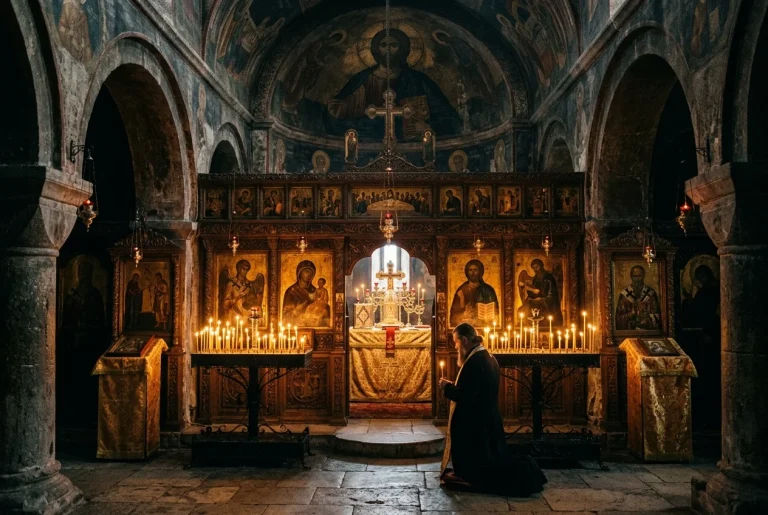
The domestic and ecclesial environment of Orthodox theological practice is visually and liturgically dense:
The Seventh Ecumenical Council and Holy Icons
Icons in Orthodox practice are not decorative artwork or emotional visual aids; they are theological confessions of faith. The Seventh Ecumenical Council (Nicaea II, 787 CE) settled the iconoclastic crisis by establishing that because the Second Person of the Trinity truly became flesh, the incarnate Lord can and must be depicted in sacred imagery. Refusing to depict Christ denies the reality of His physical Incarnation.
Orthodox Christians venerate (proskynesis) icons of Christ, the Theotokos (Virgin Mary), and the saints through kisses, bowing, and lighting candles, knowing that the honor shown to the image passes directly to the prototype (Saint Basil the Great). Every Orthodox home maintains an icon corner (krasny ugol or “beautiful corner”) facing east, anchoring daily family prayer in the visual communion of the saints.
Frequently Asked Questions
What does theosis mean in Orthodox theology?
Theosis (deification) refers to the process of spiritual transformation by which a human being becomes united with God, partaking of His uncreated divine energies and likeness (2 Peter 1:4) through faith, ascetic repentance, and the holy sacraments.
What is the Jesus Prayer in Orthodox practice?
The Jesus Prayer is an ancient meditative prayer: “Lord Jesus Christ, Son of God, have mercy on me, a sinner.” Practiced with a knotted wool prayer rope, it cultivates unceasing interior prayer, humility, and guard of the heart.
Why do Orthodox Christians pray facing east?
Orthodox Christians historically face east during corporate and private prayer because the rising sun symbolizes Christ the “Sun of Righteousness,” and Scripture teaches that the Second Coming of Christ will appear from the east (Matthew 24:27).
What is the difference between essence and energies in God?
Formulated by Saint Gregory Palamas, the distinction states that God’s divine essence (what God is in Himself) is entirely transcendent and unknowable to creatures, but His uncreated divine energies (His grace, light, and power) are fully accessible, allowing true communion between God and man.
Get our latest guides, news, and insights highlighted in your Google Search & AI Overviews.



 THE SECRET ELITES DON'T WANT YOU TO KNOW