
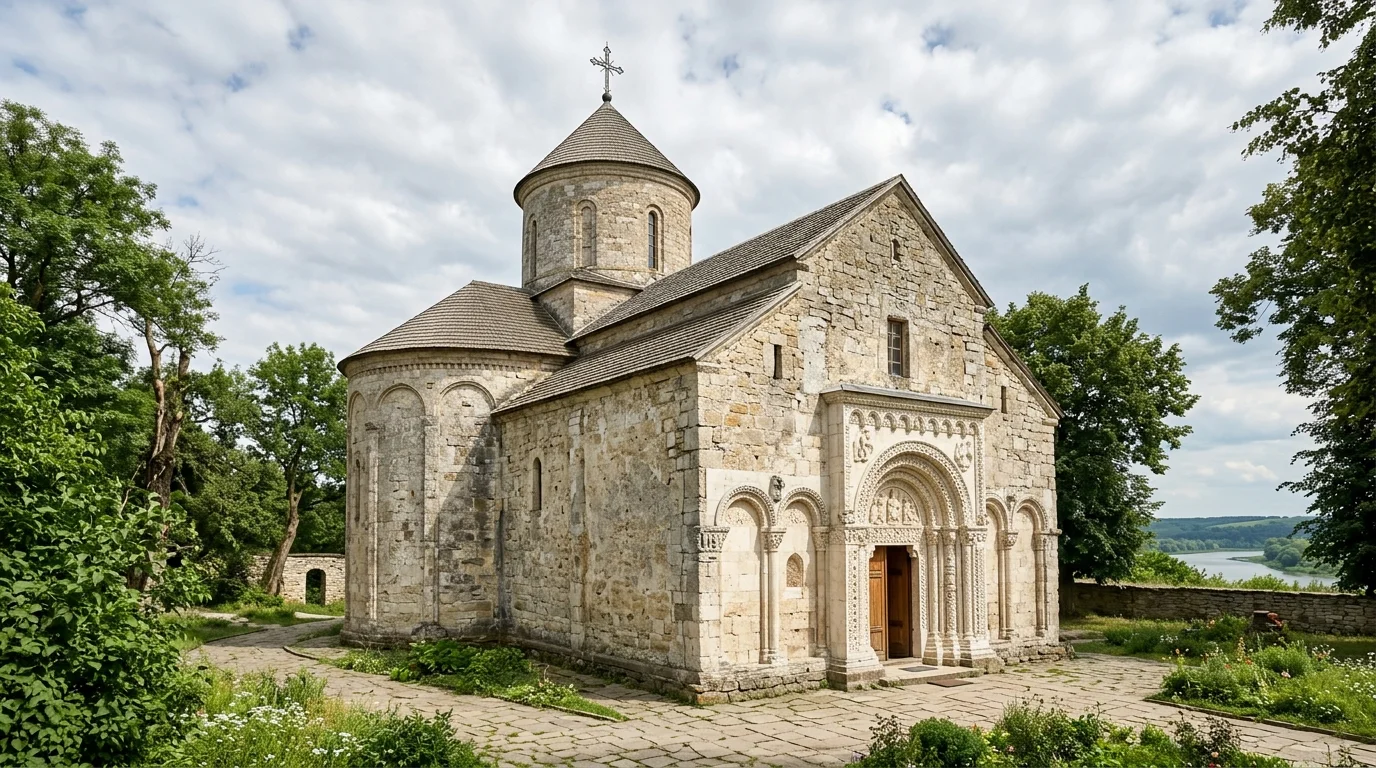
Saint Panteleimon Church in Halych (1194): History, Architecture, and Graffiti of Ukraine’s Oldest Monument
✨ This article was AI edited. Editorial responsibility: WesternChurch.net.
The Church of Saint Panteleimon in Shevchenkove (near Halych, Ivano-Frankivsk Oblast, Ukraine) was consecrated in 1194 by Prince Roman Mstislavich, standing today as the sole surviving monument of the Principality of Galicia-Volhynia. Renowned for its fusion of Western European Romanesque white-stone carving and Eastern Byzantine cruciform architecture, the structure contains over 700 medieval Cyrillic graffiti inscriptions, providing an irreplaceable historical record of early East Slavic literacy and political life.
Contents
- Historical Foundations: Prince Roman Mstislavich and the 1194 Consecration
- The Galician Architectural Synthesis: Romanesque West Meets Byzantine East
- Epigraphic Treasure: The Medieval Graffiti Inscriptions
- Transformation and Polish Royal Rule: The Church of Saint Stanislaus
- Twentieth-Century Archaeology and Canonical Restoration
- Visiting and Exploring the Historic Site
- Frequently Asked Questions
Historical Foundations: Prince Roman Mstislavich and the 1194 Consecration
Situated upon the elevated right bank of the Lukva River approximately four kilometers west of modern Halych, the Church of Saint Panteleimon represents the zenith of 12th-century Galician architectural ambition. Historical consensus attributes the church’s commissioning to Prince Roman Mstislavich (c. 1152–1205), who sought to establish a monumental dynastic sanctuary dedicated to Saint Panteleimon the Healer—the baptismal patron saint of Roman’s grandfather, Grand Prince Iziaslav II Mstislavich of Kyiv.
The definitive chronological marker establishing the church’s existence was discovered directly on its southern facade in the late 20th century. Epigraphers identified an incised medieval graffiti inscription bearing the Cyrillic date 6702 of the Byzantine era, corresponding to the year 1194 of the Julian calendar. This stone inscription marks the terminus ante quem of the original construction, confirming that the cathedral was active and decorated prior to the end of the 12th century, half a century before the Mongol invasion under Batu Khan devastated the Kyivan Rus’ urban centers in 1240.
| Architectural Feature | Technical Specification | Historical Significance |
|---|---|---|
| Foundation Date | Circa 1194 CE | Consecrated during the reign of Prince Roman Mstislavich |
| Typology | Cross-in-Square (Cruciform) | Four-columned, single-domed Byzantine plan with triapsidal east end |
| Masonry Construction | Ashlar Limestone Blocks | Fine-dressed white limestone quarried from regional Dniester deposits |
| Portal Ornamentation | Recessed Romanesque Portal | Stepped archivolts with cable moldings, palmettes, and classical capitals |
| Epigraphic Corpus | Over 700 incised graffiti texts | 12th–17th century legal, devotional, and chronological records |
| Ecclesiastical Identity | Ukrainian Greek Catholic Sanctuary | Restored national architectural landmark within Ancient Halych Preserve |
The Galician Architectural Synthesis: Romanesque West Meets Byzantine East
The Church of Saint Panteleimon occupies a celebrated position in art history because it embodies the unique geopolitical and cultural crossroads of medieval Halych. While orthodox Kyivan architecture of the period relied primarily on fired ceramic plinthite brick and mortar bands (opus mixtum), Galician master builders adopted the sophisticated ashlar stone masonry techniques characteristic of Central European Romanesque workshops in Poland, Hungary, and the Holy Roman Empire.
The structural layout adheres to the classical Byzantine cross-in-square model:
- Cruciform Core: Four square masonry piers support four broad semi-circular arches, forming a central bay crowned by a cylindrical light drum and dome.
- Triapsidal Altar: Three semicircular apses project toward the east, with the central presbytery apse rising significantly higher and wider than the flanking prothesis and diaconicon niches.
- Ashlar Exterior: The external perimeter walls are constructed from two parallel skins of finely squared white limestone blocks, with the interior cavity filled with a compacted lime-and-rubble concrete core.
- Stepped Western Portal: The primary western entrance displays a dramatic perspective Romanesque portal consisting of concentric stepped stone arches decorated with vegetal tendrils, bead-and-reel motifs, and zoomorphic column capitals.
Epigraphic Treasure: The Medieval Graffiti Inscriptions
Unlike churches whose historical documentation survives solely in monastic chronicles, Saint Panteleimon carries its primary historical archive directly upon its limestone walls. In the 1980s and 1990s, Ukrainian epigraphers and historians, led by Vyacheslav Korniyenko and Boris Dobryansky, conducted systematic macro-photographic surveys of the exterior and interior masonry surfaces, cataloging over 700 distinct graffiti inscriptions.
These inscriptions were incised into the soft limestone using iron styluses or knife points. The texts range from brief prayer formulas (“Lord, help thy servant…”) to official legal certifications documenting land boundaries, diplomatic oaths, and witness signatures of boyars and princely administrators. The presence of multiple scripts—predominantly Old Church Slavonic with distinct Galician linguistic traits, interspersed with occasional Latin and Armenian notations—attests to the multi-ethnic commercial and religious life of Halych as a trade emporium connecting the Black Sea, Poland, and Bohemia.
Transformation and Polish Royal Rule: The Church of Saint Stanislaus
Following the decline of the Galician-Volhynian state and the expansion of the Kingdom of Poland under King Casimir III in the mid-14th century, the church underwent a major confessional transformation. In 1367, the Polish Crown transferred the sanctuary to the Roman Catholic Archdiocese of Lviv. The structure was rededicated to Saint Stanislaus of Szczepanów, the patron saint of Poland and the Royal Wawel Cathedral.
During the late 16th century, Polish nobleman and Crown Chancellor Jan Zamoyski assigned the property to the Order of Friars Minor Conventual (Franciscans). The friars constructed a surrounding fortified monastery complex, complete with defensive earthen ramparts, stone bastions, and a detached defensive bell tower. To accommodate Roman Catholic liturgical practices, the interior was renovated: the Byzantine iconostasis was removed, Baroque altars were introduced, and secondary windows were cut through the 12th-century masonry. Despite surviving multiple Tatar and Ottoman raids, the church suffered extensive artillery damage during the fierce military campaigns of World War I in 1915.
Twentieth-Century Archaeology and Canonical Restoration
Throughout the 20th century, prominent Ukrainian and Polish art historians recognized the critical architectural value of Saint Panteleimon. Extensive structural excavations and archaeological soundings conducted by Jozef Pelensky in 1909–1911 and later by the National Academy of Sciences of Ukraine identified the original 1194 floor levels, buried pilasters, and foundations of the original exonarthex.
Following the declaration of Ukrainian independence in 1991, the complex became a premier restoration priority for the newly formed “Ancient Halych” National Historical and Cultural Preserve. Between 1996 and 1998, a comprehensive restoration program directed by architect Ivan Mohytych stripped away later structural distortions, reinstated the Romanesque-Byzantine roofline, restored the limestone drum and hemispherical dome, and cleaned the exterior facades to safeguard the fragile epigraphic graffiti. Today, the consecrated sanctuary functions under the canonical jurisdiction of the Ukrainian Greek Catholic Church, hosting regular Sunday liturgies while welcoming researchers and pilgrims from around the world.
Visiting and Exploring the Historic Site
For visitors traveling through Western Ukraine, Saint Panteleimon Church offers an unmatched window into the medieval golden age of Halych-Volhynia:
- Location: Shevchenkove village, Halych Raion, Ivano-Frankivsk Oblast (approx. 25 km north of Ivano-Frankivsk city center).
- Access: Accessible via the H09 highway connecting Lviv and Ivano-Frankivsk, followed by a short spur toward the Lukva River heights.
- Preserve Status: Part of the “Ancient Halych” National Reserve, which also includes the Halych Castle ruins, the Museum of History of Ancient Halych in Krylos, and the open-air folk architecture museum.
- Architectural Highlights: Make sure to inspect the preserved western perspective portal carvings and the low-relief cross motifs etched across the southern limestone blocks.
Frequently Asked Questions
When was the Church of Saint Panteleimon in Ukraine built?
The Church of Saint Panteleimon was founded circa 1194 by Prince Roman Mstislavich of Halych. A medieval graffiti inscription discovered on its walls bears the specific date 1194 (year 6702 of the Byzantine era), confirming its consecration in the late 12th century.
What architectural style is Saint Panteleimon Church?
The church features a hybrid Romanesque-Byzantine architectural style. It combines an Eastern Orthodox cruciform cross-in-square four-pillar plan with Western European Romanesque white-stone ashlar masonry, carved perspective portals, and stepped exterior archivolts.
Why was the church later renamed Saint Stanislaus?
In the 14th century, after Poland annexed Galicia under Casimir III, the building was transferred to Roman Catholic administration in 1367 and rededicated to Saint Stanislaus. It was subsequently managed by Franciscan monks until the 20th century.
Can you see the medieval graffiti on the church walls?
Yes. Over 700 medieval graffiti inscriptions are preserved on the exterior and interior limestone walls of the church, including names of medieval boyars, legal notices, Cyrillic prayers, and historical dating formulas.
Get our latest guides, news, and insights highlighted in your Google Search & AI Overviews.



 FINAL WARNING