
What Happens During Mass — Complete Guide | Western Church
✨ This article was AI edited. Editorial responsibility: WesternChurch.net.
What happens during Mass is a structured sacred dialogue between God and His people, where the Christian community gathers to hear the Holy Scriptures proclaimed, offer corporate prayers of thanksgiving and intercession, and celebrate the Holy Sacrifice of the Eucharist in an atmosphere of sacred reverence and song.
For someone entering a Catholic church for the first time—or for a Christian returning after many years—attending Mass can evoke feelings of wonder mixed with curiosity. Why does the priest kiss the altar? Why do bells chime in the middle of a silent prayer? Why does the entire congregation stand up, sit down, and kneel together in rhythm? Knowing what happens during Mass transforms the experience from a series of mysterious rituals into a profoundly personal, spiritually uplifting encounter with God.
Contents
- The Sacred Rhythm: What You Experience From Start to Finish
- 1. Entering the Church: The Holy Water Font
- 2. Taking Your Seat: Genuflecting to the Tabernacle
- 3. The Opening Hymn and Liturgical Greeting
- 4. Asking for Forgiveness: The Penitential Rite
- 5. Hearing God’s Word Proclaimed
- 6. The Homily and the Creed
- 7. The Eucharistic Mystery and Consecration
- 8. The Lord’s Prayer and Sign of Peace
- 9. Receiving Holy Communion
- 10. The Blessing and Dismissal
- Sensory and Symbolic Elements Found in Mass
- Etiquette and Helpful Advice for Visitors
- Frequently Asked Questions
The Sacred Rhythm: What You Experience From Start to Finish
The Catholic Mass is designed to engage the whole person—mind, heart, senses, and body. Unlike a lecture or concert where an audience watches performers on a stage, the Mass is an interactive liturgy where the entire congregation actively participates in prayer, song, physical postures, and sacramental reception.
Here is an authentic walkthrough of what occurs as you walk through the church doors on a Sunday morning:
1. Entering the Church: The Holy Water Font
Near the entrance doors (the narthex), you will see small basins called holy water fonts. Catholics dip the fingers of their right hand into the blessed water and make the Sign of the Cross over their forehead, chest, and shoulders. This gesture reminds believers of their initial baptism and sets apart the sanctuary as consecrated holy ground.
2. Taking Your Seat: Genuflecting to the Tabernacle
Before stepping into a wooden pew, worshipers turn toward the altar and the Tabernacle (a gold-lined chest, usually indicated by a red sanctuary lamp burning nearby) and bend their right knee all the way to the floor—a gesture known as genuflecting. This is an ancient act of humble homage paid to Christ, who is truly present in the reserved Eucharist.
3. The Opening Hymn and Liturgical Greeting
The organ or choir begins, the congregation stands, and the priest processes down the center aisle. Standing at the altar, the priest greets the people: “In the name of the Father, and of the Son, and of the Holy Spirit… The Lord be with you.” The assembly responds: “And with your spirit.”
4. Asking for Forgiveness: The Penitential Rite
Before hearing the Word of God, everyone acknowledges their human faults and sins. In quiet humility, the congregation prays: “Lord, have mercy; Christ, have mercy; Lord, have mercy.” This cleanses the heart and restores peace among neighbors.
5. Hearing God’s Word Proclaimed
Everyone sits down to listen to ancient scriptures read aloud from the ambo (lectern). You will hear three distinct readings on Sundays:
- First Reading: Stories of prophecy, covenant, and history from the Old Testament.
- Responsorial Psalm: An emotional prayer of praise, lament, or thanksgiving from King David and the biblical psalmists.
- Second Reading: Practical pastoral letters written by Saint Paul and early apostles to early Christian communities.
- The Holy Gospel: The climax of the readings. Everyone stands to sing “Alleluia,” and the priest reads the direct words and actions of Jesus Christ from Matthew, Mark, Luke, or John.
6. The Homily and the Creed
The congregation sits as the priest delivers a homily—a 10-to-15-minute reflection explaining how the day’s scriptures apply to modern struggles, family life, and ethical decisions. Afterward, everyone stands together to recite the Nicene Creed, affirming faith in one God, the Father almighty, maker of heaven and earth.
7. The Eucharistic Mystery and Consecration
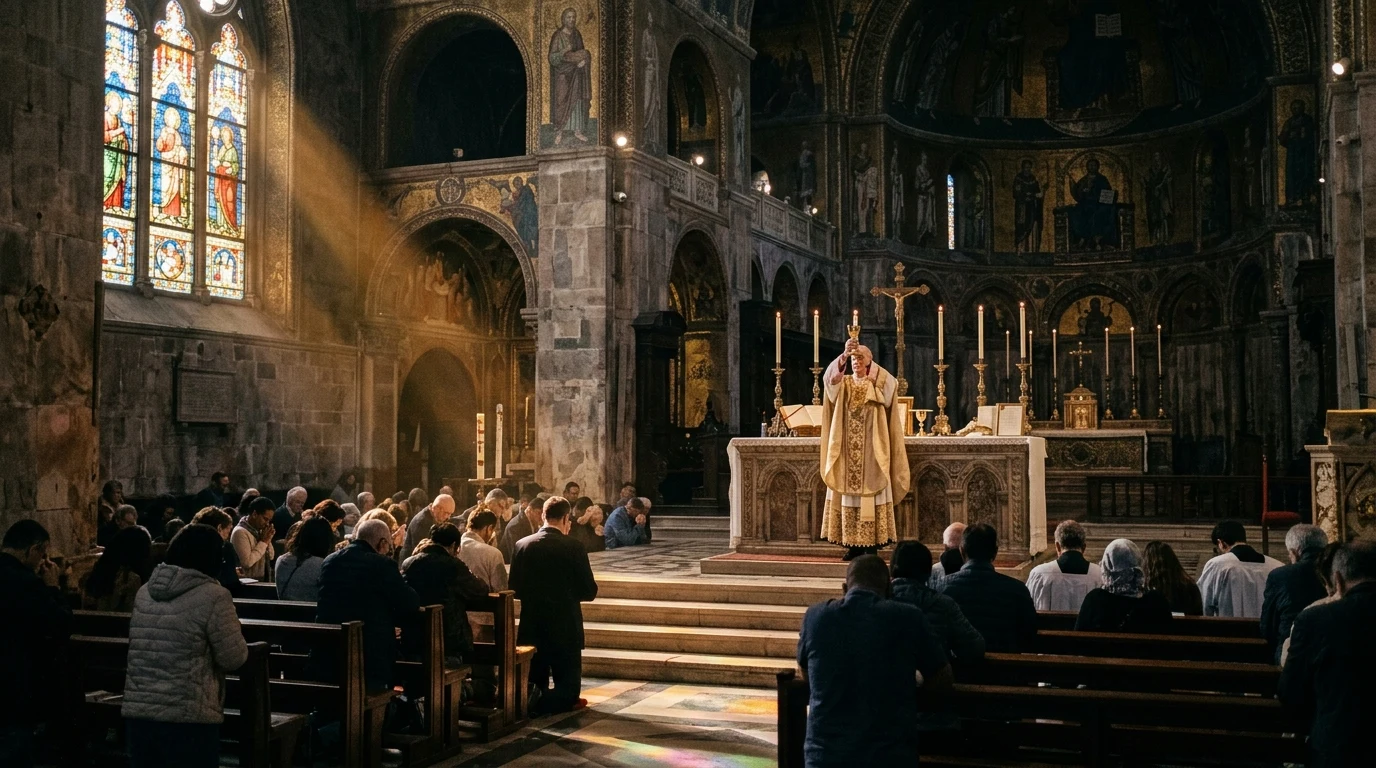
This is the spiritual core of what happens during Mass. The congregation kneels in silence as the priest raises simple unleavened wheat bread and grape wine, echoing Christ’s words from the Last Supper:
“Take this, all of you, and eat of it, for this is my Body, which will be given up for you… Take this, all of you, and drink from it, for this is the chalice of my Blood…”
As the priest elevates the host and chalice towards heaven, altar bells chime to mark the sacred moment of transubstantiation—when the bread and wine become the real presence of Jesus Christ. The congregation responds with the Great Amen.
8. The Lord’s Prayer and Sign of Peace
Standing together, the assembly prays the Our Father. The priest then invites the people: “Let us offer each other the sign of peace.” Turning to those around them in the pews, worshipers shake hands or nod with a warm smile, saying, “Peace be with you.”
9. Receiving Holy Communion
Congregants walk forward single-file down the aisle. Practicing Catholics receive the consecrated Host, while visitors and seekers may cross their arms over their chest to receive an individual blessing. Returning to their seats, worshipers kneel in quiet thanksgiving.
10. The Blessing and Dismissal
The priest offers a final blessing and sends the congregation out into the world with words of mission: “Go forth, the Mass is ended” or “Go in peace, glorifying the Lord by your life.” The service concludes with an uplifting closing hymn.
Sensory and Symbolic Elements Found in Mass
The Catholic Mass is rich in multi-sensory symbolism that speaks directly to human perception:
| Sensory Element | Biblical / Theological Meaning | When It Appears |
|---|---|---|
| Burning Incense | Symbolizes the prayers of the saints rising to heaven (Psalm 141:2; Revelation 8:4). | Solemn feast days, processing, and altar censing. |
| Altar Candles | Represents Christ as the Light of the World shining in darkness. | Burning on or near the altar throughout every Mass. |
| Altar Bells | Alerts the assembly to the solemn miracle of the Consecration. | Chimed during the elevation of the Host and Chalice. |
| Liturgical Colors | Green (Ordinary Time / Hope), Violet (Penance / Advent & Lent), White/Gold (Feasts & Easter), Red (Pentecost & Martyrs). | Priest’s vestments and sanctuary drapery. |
| Sign of the Cross | Marks the believer as redeemed by the Crucifixion and dedicated to the Holy Trinity. | Beginning, ending, Gospel acclamation, and blessings. |
Etiquette and Helpful Advice for Visitors
If you are planning to attend Mass for the first time, keep these practical tips in mind:
- Arrive 5–10 Minutes Early: This gives you time to sit quietly in the sanctuary, look over the printed hymnal or parish bulletin, and settle your thoughts.
- Follow Along With Postures: Stand when the congregation stands, sit when they sit, and sit back comfortably in the pew if you prefer not to kneel.
- Cell Phones: Please silence or power off mobile devices before entering the sanctuary.
- Questions After Mass: Priests and parishioners are always happy to chat after Mass in the vestibule or parish hall during coffee fellowship.
To continue your journey into Christian liturgical history, explore our comprehensive companion guides on the detailed step-by-step Catholic Mass process, the theological distinction in Mass vs. Communion, and our introduction to global Christian liturgical traditions.
Frequently Asked Questions
What does a visitor do during Communion?
Visitors who are not Catholic can either remain seated in their pew in quiet prayer, or join the line with their arms crossed over their chest (palms resting on opposite shoulders). This signals to the priest that you would like to receive an individual blessing instead of the Eucharistic host.
Do I have to give money when the collection basket passes?
No. Giving is entirely voluntary. The collection basket is passed to support the local parish, church upkeep, and charitable ministries for the poor. Visitors are under no financial obligation whatsoever.
Is Mass boring for children?
Many parishes offer “Children’s Liturgy of the Word” during the readings, where young children are guided through the scriptures at an age-appropriate level before rejoining their families for the Eucharistic prayer. Families with small children are always warmly embraced.
Can I take pictures or record video during Mass?
Photography and recording are generally discouraged during regular worship to maintain a sacred, prayerful atmosphere. Exceptions are made during major family celebrations like weddings, baptisms, and first communions, typically handled by designated photographers.
Get our latest guides, news, and insights highlighted in your Google Search & AI Overviews.


 URGENT: THIS PAGE COULD DISAPPEAR!