
The Orthodox Canon of Scripture: Old and New Testament Books and Patristic Authority
✨ This article was AI edited. Editorial responsibility: WesternChurch.net.
The Orthodox canon of scripture is the comprehensive 76-book collection of sacred biblical texts recognized by the Eastern Orthodox Church, rooted in the Greek Septuagint (LXX) Old Testament—containing 49 books including 3 Maccabees, 1 Esdras, and the Prayer of Manasseh—alongside the universally received 27 New Testament books.
When Christians compare different editions of the Holy Bible, one of the most striking discoveries is that the biblical canon varies across traditions. While Protestant Bibles contain 66 books and Roman Catholic Bibles contain 73 books, the Holy Scriptures received and venerated by the Eastern Orthodox Church comprise a broader, richer collection numbering 76 books (and in Slavic traditions, 77 with 4 Maccabees as an appendix). Understanding the Orthodox canon of scripture requires exploring how the apostolic Church adopted the Greek Septuagint as its primary Bible and how ancient regional synods preserved books that Western Christendom later set aside.
Contents
- The Foundation: The Greek Septuagint (LXX)
- Old Testament Books in the Orthodox Canon
- The 27 New Testament Books
- Comparative Canon Overview: Orthodox vs. Catholic vs. Protestant
- Patristic Councils and the Concept of “Anagignoskomena”
- How Scripture Functions Within the Orthodox Liturgy
- Frequently Asked Questions
The Foundation: The Greek Septuagint (LXX)
Unlike the Western Catholic tradition (which standardized upon Saint Jerome’s Latin Vulgate translated largely from the Hebrew Masoretic Text) and the Protestant Reformers (who restricted the Old Testament to the 39 books of the Jewish Tanakh), the Eastern Orthodox Church has always granted normative canonical authority to the Septuagint. Translated in Alexandria, Egypt, between the third and second centuries BC by Jewish scholars, the Septuagint was the Bible quoted directly by Jesus Christ, the Evangelists, and Saint Paul in the vast majority of New Testament quotations.
The Orthodox Church teaches that the Septuagint translation was providentially inspired by the Holy Spirit to prepare the Gentile Greco-Roman world for the Incarnation of the Word. Key prophetic passages—such as Isaiah 7:14 predicting that a parthenos (virgin) would conceive—stem directly from the Septuagint reading.
Old Testament Books in the Orthodox Canon
The Orthodox Old Testament contains 49 canonical books, classified into historical, poetic/wisdom, and prophetic divisions. It incorporates all 39 books found in Protestant Bibles, plus the deuterocanonical books recognized by Rome, along with several texts preserved uniquely in the Eastern Christian patrimony:
- Tobit: A narrative illustrating divine providence, angelic assistance through Archangel Raphael, and matrimonial holiness.
- Judith: The historic account of a pious widow’s courageous deliverance of Bethulia.
- 1 and 2 Maccabees: The heroic chronicle of the Hasmonean revolt against Antiochus IV Epiphanes and the rededication of the Temple.
- Wisdom of Solomon: Sublime theological meditation on divine Wisdom and human immortality.
- Sirach (Ecclesiasticus): Moral, family, and spiritual wisdom compiled by Jesus ben Sira.
- Baruch and the Letter of Jeremiah: Prophetic calls to repentance and critiques of idolatry.
- Additions to Daniel: The Prayer of Azariah, the Song of the Three Holy Children, Susanna, and Bel and the Dragon.
- Additions to Esther: Six extended chapters detailing Esther’s prayers and the imperial decrees.
2. Additional Books Unique to the Orthodox Canon
- 1 Esdras (3 Ezra): The Greek historical narrative of the restoration of the Temple and the famous rhetorical contest: “Truth is greatest and strongest of all.”
- 3 Maccabees: Chronicling God’s miraculous deliverance of Egyptian Jews under Ptolemy IV Philopator at the Alexandria hippodrome.
- Prayer of Manasseh: A deeply moving penitential prayer uttered by the repentant King of Judah, recited regularly in Great Compline.
- Psalm 151: An inspired autobiographical psalm attributed to David following his victory over Goliath, appended to the Psalter.
- 4 Maccabees (Slavic Appendix / Greek Recension): A philosophical and spiritual discourse on the supremacy of devout reason over passions, exemplified by the Eleazar and Seven Maccabean Martyrs.
The 27 New Testament Books
In contrast to Old Testament variations, the Eastern Orthodox New Testament is identical to that used by Catholics and Protestants worldwide, consisting of 27 books: the Four Gospels, Acts of the Apostles, fourteen Pauline Epistles (including Hebrews), seven Catholic (General) Epistles, and the Apocalypse of Saint John (Revelation).
Notably, the Book of Revelation holds a unique liturgical distinction in the Orthodox Church: while recognized as divinely inspired scripture, it is the only New Testament book never read publicly during the liturgical Divine Services. This practice dates back to early Eastern caution regarding millennialist misinterpretations.
Comparative Canon Overview: Orthodox vs. Catholic vs. Protestant
| Biblical Section / Book | Protestant Canon | Roman Catholic Canon | Eastern Orthodox Canon |
|---|---|---|---|
| Total Book Count | 66 Books (39 OT / 27 NT) | 73 Books (46 OT / 27 NT) | 76 Books (49 OT / 27 NT) |
| Old Testament Textual Base | Hebrew Masoretic Text | Latin Vulgate / Hebrew & Greek | Greek Septuagint (LXX) |
| Tobit & Judith | Apocrypha (non-canonical) | Deuterocanonical (Canonical) | Canonical (Anagignoskomena) |
| 1 & 2 Maccabees | Apocrypha (non-canonical) | Deuterocanonical (Canonical) | Canonical (Anagignoskomena) |
| 3 Maccabees | Excluded | Excluded | Canonical |
| 1 Esdras (Greek Ezra) | Excluded | Excluded (Vulgate Appendix) | Canonical |
| Prayer of Manasseh & Psalm 151 | Excluded | Excluded (Vulgate Appendix) | Canonical |
| New Testament Books | 27 Books | 27 Books | 27 Books |
Patristic Councils and the Concept of “Anagignoskomena”
In Orthodox theological nomenclature, the additional Old Testament books are formally known as the Anagignoskomena (Greek: ἀναγιγνωσκόμενα, meaning “books worthy of being read”). This designation originates from early Church fathers like Saint Athanasius the Great and Saint Cyril of Jerusalem, who distinguished between books universally read in public liturgy and those reserved for catechetical instruction.
The definitive historical boundaries of the Orthodox canon were affirmed at local and regional synods with ecumenical reception, including:
- The Synod of Laodicea (c. 363 AD): Establishing early reading lists for public worship.
- The 85th Apostolic Canon and Carthage (419 AD): Endorsed by the Quinisext Council (Trullo, 692 AD).
- The Synod of Jerusalem (1672 AD): Convened by Patriarch Dositheos of Jerusalem to refute Calvinist encroachments, formally reaffirming the full inspiration and canonical authority of the traditional Septuagint books.
How Scripture Functions Within the Orthodox Liturgy
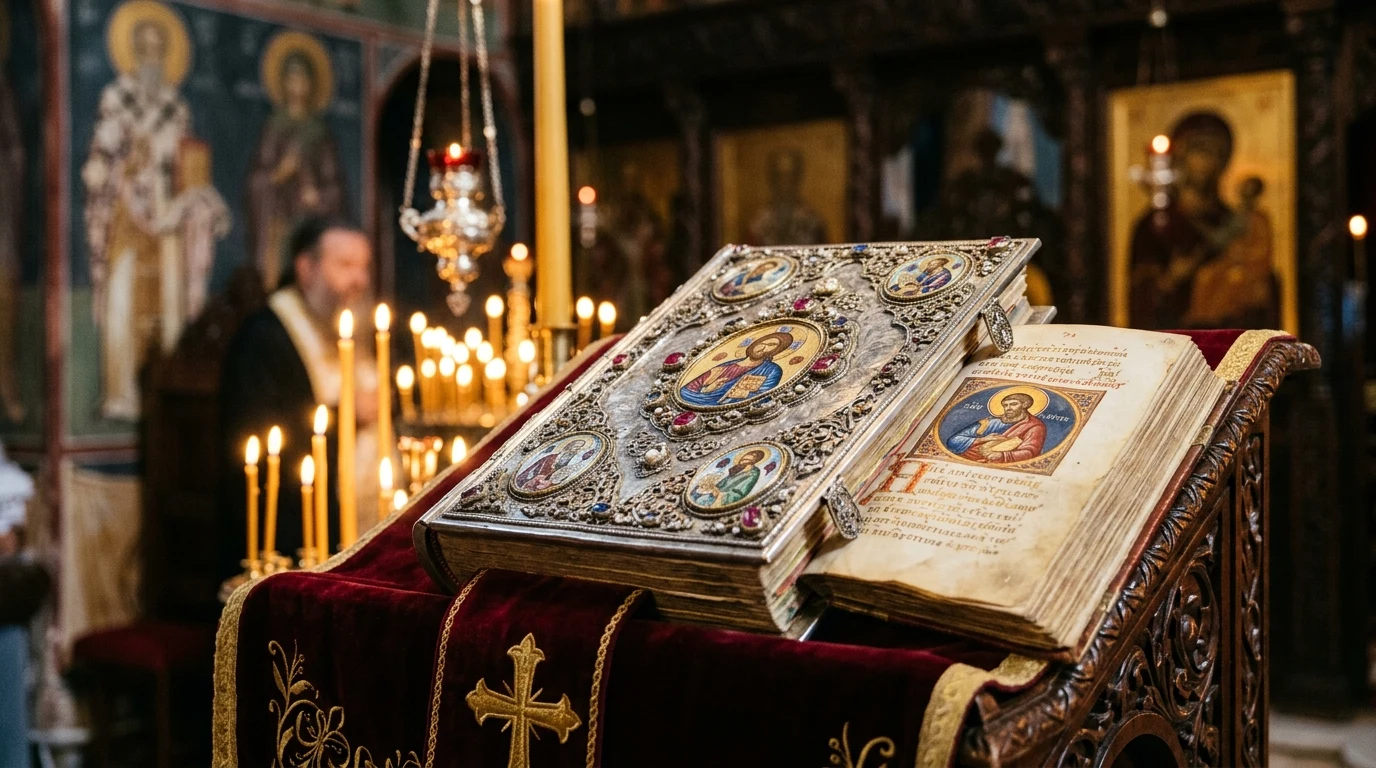
In Eastern Orthodoxy, the Bible is not viewed as an isolated academic text detached from the Church, but as the verbal icon of Christ living within the heart of holy Tradition. Scripture was born inside the worshipping assembly, and it is in the Divine Liturgy that its fullest meaning is unlocked. During every service, the Gospel Book is reverenced with prostrations, carried in solemn procession, and placed permanently on the center of the holy altar table.
To further examine the deep historical and textual traditions of Eastern Christianity, continue reading our companion guides on the historical councils and manuscripts of the Eastern canon, our study of Orthodox theology and tradition, and our guide to sacred liturgical rites.
Frequently Asked Questions
How many books are in the Eastern Orthodox Bible?
The Eastern Orthodox Bible contains 76 canonical books: 49 Old Testament books based on the Greek Septuagint, and 27 New Testament books. Some Slavic traditions print 4 Maccabees as a 77th book in an appendix.
Why does the Orthodox Bible have more books than Protestant and Catholic Bibles?
The Orthodox Church inherited and preserved the full collection of books contained in the Greek Septuagint, the translation used by the Greek-speaking early Church. While Western traditions narrowed their Old Testament canons based on later Hebrew or Latin criteria, the Orthodox Church maintained the broader ancient apostolic collection.
What is the Septuagint?
The Septuagint (often abbreviated LXX) is the ancient Greek translation of the Hebrew Old Testament completed in Alexandria between 250 and 150 BC. It was the primary scriptural text used by the Apostles and early Church Fathers.
Is the Book of Revelation in the Orthodox Bible?
Yes. The Book of Revelation (the Apocalypse of Saint John) is fully recognized as canonical scripture in the Orthodox Church. However, according to ancient tradition, it is the only New Testament book not read aloud during the public Divine Liturgy.
Get our latest guides, news, and insights highlighted in your Google Search & AI Overviews.



 FINAL WARNING