
Translation Devices for Churches — Tech Guide | Western Church
✨ This article was AI edited. Editorial responsibility: WesternChurch.net.
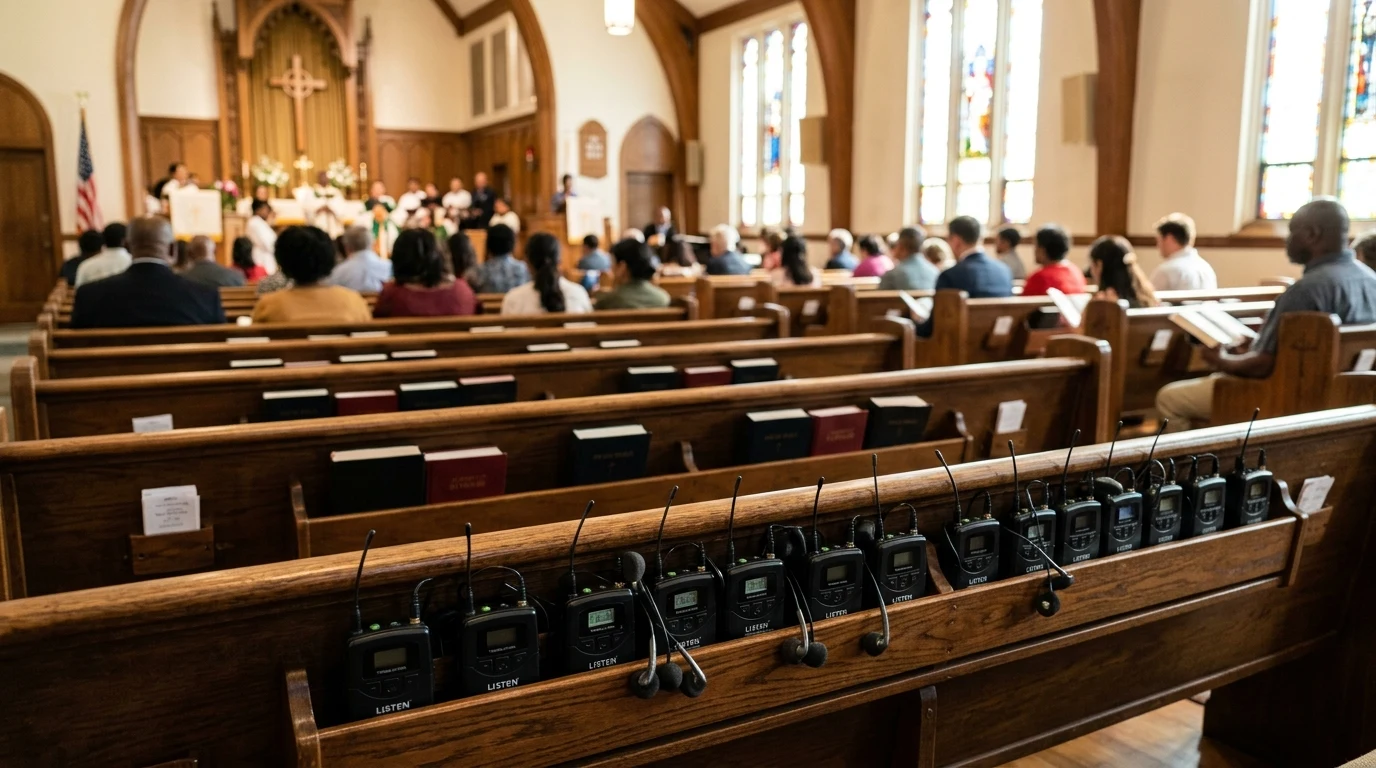
Translation devices for churches are specialized multi-channel audio transmission systems—utilizing radio frequency (RF), infrared (IR), or local Wi-Fi networks—that allow volunteer human or AI interpreters to broadcast real-time translated sermons, scripture readings, and prayers directly to wireless pocket receivers or congregation smartphones.
As communities worldwide grow increasingly diverse, multilingual church ministry has expanded from an occasional specialty outreach into a vital core ministry. Congregations regularly welcome immigrant families, international students, refugees, and diaspora communities who desire to worship in their mother tongue while remaining united under one roof. Modern translation devices for churches provide seamless, discreet, and cost-effective simultaneous interpretation, ensuring every congregant experiences the Word of God with full linguistic clarity and spiritual intimacy.
Contents
Why Multilingual Ministry Requires Dedicated Hardware
While some congregations initially attempt acoustic translation—placing an interpreter in the back of the room whispering to a small cluster of listeners—this approach suffers from major shortcomings: speech spillover distracts neighboring worshipers, ambient sanctuary reverberation degrades clarity, and congregants are segregated into physical corners. Professional simultaneous interpretation equipment resolves these challenges by creating a dedicated private audio feed.
Investing in purpose-built church translation systems provides threefold benefits:
- Complete Inclusion: Multilingual members and visitors sit anywhere in the sanctuary alongside family and friends without spatial confinement.
- Dual Accessibility (ADA Compliance): Most 72 MHz and digital translation transmitters also qualify as assistive listening devices for hard-of-hearing members, fulfilling municipal accessibility requirements.
- Zero Liturgical Distraction: Interpreters speak into noise-canceling headset microphones from a sound booth or quiet room, maintaining sanctuary solemnity.
Core Transmission Technologies: RF vs. Wi-Fi vs. Infrared
When selecting a translation system for your church sanctuary, leadership teams must evaluate the underlying transmission technology based on sanctuary architecture, congregation tech-savviness, and budget.
1. Radio Frequency (RF: 72 MHz, 216 MHz, or 900 MHz Digital)
RF systems remain the industry gold standard for houses of worship. The setup consists of a central stationary transmitter wired into the church soundboard or an interpreter’s microphone, paired with lightweight battery-operated pocket beltpack receivers and single-ear earpieces.
- Advantages: Superior reliability, zero latency, penetrates stone walls and pillars, works instantly without smartphone setup, extremely easy for elderly attendees.
- Drawbacks: Requires sanitizing, charging, and distributing hardware packs every Sunday; finite channel capacity on entry-level models.
2. Wi-Fi Audio Streaming (Bring Your Own Device — BYOD)
Wi-Fi-based audio servers (such as ListenWiFi or Williams Sound WaveCAST) connect to the sanctuary audio console and broadcast multi-channel audio over the church’s local Wi-Fi router. Congregants download a free smartphone app, plug in their own personal earbuds, and select their language channel.
- Advantages: Unlimited receiver capacity without purchasing extra hardware; no Sunday morning equipment check-out or battery management; guests use familiar earbuds.
- Drawbacks: Dependent on high-performance enterprise Wi-Fi routers; slight buffer latency (20–80ms); requires attendees to have charged smartphones and app installation comfort.
3. Infrared (IR) Systems
Infrared systems transmit audio through invisible light waves emitted by radiator panels installed on sanctuary walls. Receivers detect line-of-sight light signals to decode audio.
- Advantages: Absolute security and privacy (signals cannot pass through exterior walls or stained glass); zero radio frequency interference from municipal wireless systems.
- Drawbacks: Line-of-sight restriction (audio drops if someone steps behind a pillar); higher installation cost; sensitive to direct sunlight through large sanctuary windows.
Comparison Matrix: Church Translation Hardware Technologies
| System Feature | Digital Radio Frequency (RF) | Wi-Fi Audio Streaming (BYOD) | Infrared (IR) Radiator |
|---|---|---|---|
| Coverage Range | Up to 300–500 ft (line-of-sight not required) | Entire Wi-Fi coverage zone (mesh routers) | Line-of-sight only within main hall |
| Audio Latency | Ultra-low (< 5 milliseconds) | Low (20–80 milliseconds buffer) | Zero latency (< 1 millisecond) |
| Listener Device | Dedicated beltpack receiver + earpiece | Personal smartphone + personal earbuds | Specialized IR sensor headset/necklace |
| Initial Setup Complexity | Plug-and-play into audio mixer | Requires dedicated network router/VLAN | Professional wall-mounting required |
| Congregation Tech Barrier | None (just turn power dial on beltpack) | Moderate (app download, Wi-Fi pairing) | None (simple on/off headset switch) |
| Sanctuary Suitability | Historic stone churches, cathedrals, chapels | Modern auditoriums, youth ministries | Confidential council chambers, boardrooms |
Leading Church Translation Hardware Brands in 2026
Three premier manufacturers dominate the house of worship assistive listening and translation market:
- Listen Technologies (ListenTalk & Listen Everywhere): The gold standard in versatile church audio. ListenTalk offers lightweight 1.9 GHz transceivers capable of two-way communication between pastor and interpreters, while Listen Everywhere powers best-in-class Wi-Fi smartphone streaming over low-latency server hardware.
- Williams AV (SoundPlus & WaveCAST): Long-standing market leaders providing ultra-reliable 72 MHz FM transmitters and hybrid WaveCAST units that transmit simultaneously over RF and Wi-Fi, providing the ultimate redundancy.
- Retekess & Enersound (Cost-Effective Portable Units): Excellent turnkey multi-channel portable tour-guide style transmitters ideal for church plants, mobile chapels, portable translation booths, and ministries operating on modest introductory budgets.
Best Practices for Implementing a Translation Ministry
Securing the right hardware is only half the battle; establishing a smooth Sunday morning workflow guarantees ministry longevity:
- Establish a Sound-Isolated Interpreter Booth: Interpreters must hear the pastor’s voice clearly in their headphones without sanctuary echo, and their own vocal translation must not bleed back into nearby microphones.
- Provide Sermon Outlines and Scripture in Advance: Share liturgical bulletins, sermon sermon notes, and scripture readings with volunteer translators on Thursday or Friday so they can prepare theological vocabulary beforehand.
- Implement a Simple Check-Out Kiosk: Position a welcoming welcome desk in the narthex or foyer where trained hospitality team members assist newcomers with pairing earpieces or downloading the translation app.
- Maintain Battery and Hygiene Discipline: Invest in drop-in multi-unit charging docks and provide sanitary disposable earbud covers or encourage members to bring their standard 3.5mm personal headphones.
As churches expand their mission to embrace believers of all nations and tongues, deploying dependable translation infrastructure bridges cultural divides and fosters authentic spiritual unity. To learn more about liturgical structures, parish ministries, and historic sacred architecture, browse our in-depth guides on historic parish church models, global Christian traditions, and liturgical worship guides.
Frequently Asked Questions
How much does a church translation system cost?
Turnkey portable entry-level multi-channel RF systems start between $300 and $800 for a transmitter and 5 to 10 receivers. Mid-tier permanent commercial RF and Wi-Fi streaming servers from Listen Technologies or Williams AV range from $1,500 to $4,500 depending on receiver count and sanctuary audio architecture.
Can smartphones be used for church translation?
Yes. Wi-Fi audio streaming systems (BYOD) allow church members to listen to real-time sermon interpretation directly through their personal smartphones using a free mobile app and personal headphones, eliminating the need to sanitize and charge individual beltpacks.
Do translation devices work for the hard-of-hearing?
Yes. Most RF systems operating on the 72 MHz and 216 MHz bands are dual-purpose Assistive Listening Systems (ALS). When paired with neckloop telecoil (T-coil) lanyards, they transmit crystal-clear audio directly into congregants’ hearing aids or cochlear implants.
How many languages can a church translate at the same time?
Multi-channel digital and RF systems easily accommodate 2 to 16 distinct languages simultaneously. Each language stream requires its own transmitter channel and human or AI interpreter feed.
Get our latest guides, news, and insights highlighted in your Google Search & AI Overviews.


 PROSPERITY PRAYER