
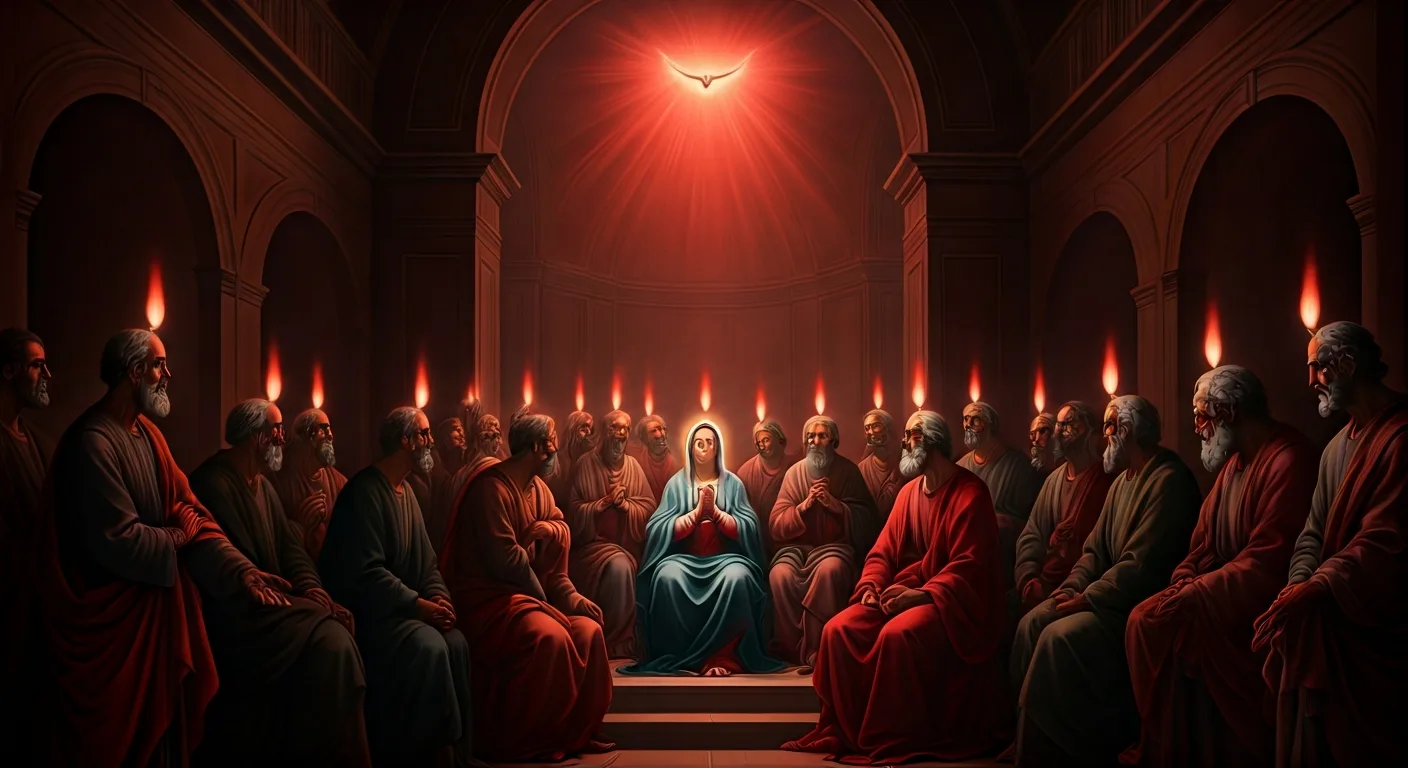
Pentecost Sunday in the Catholic Church: The Descent of the Holy Spirit
In the liturgical calendar of the Catholic Church, Pentecost Sunday stands alongside Easter and Christmas as one of the three supreme solemnities of the liturgical year. Celebrated precisely fifty days after the glorious resurrection of Jesus Christ on Easter Sunday (from the Greek pentēkostē, meaning "fiftieth"), Pentecost marks the dramatic descent of the Holy Spirit upon the Virgin Mary and the Apostles gathered in prayer in the Upper Room (the Cenacle) in Jerusalem.
Universally venerated as the "Birthday of the Church," Pentecost signals the end of the Easter season and the explosive public inaugurating of the Church’s universal mission to preach the Gospel to all nations. Below is an authoritative exploration of the biblical foundations, Old Testament typology, liturgical rites, and enduring spiritual significance of Pentecost in Catholic tradition.
Contents
- The Biblical Account: Tongues of Fire and the Rushing Wind
- Old Testament Typology: From Shavuot at Sinai to Pentecost in Jerusalem
- Why Pentecost is Called the Birthday of the Church
- Catholic Liturgical Celebrations: Red Vestments, Sequences, and Rose Petals
- The Seven Gifts of the Holy Spirit and Confirmation
- Frequently Asked Questions
The Biblical Account: Tongues of Fire and the Rushing Wind
The definitive historical account of Pentecost is recorded in the second chapter of the Acts of the Apostles. Prior to His Ascension, Jesus instructed His disciples not to depart from Jerusalem, but to wait for the promise of the Father: "You shall receive power when the Holy Spirit has come upon you; and you shall be my witnesses in Jerusalem and in all Judea and Samaria and to the end of the earth" (Acts 1:8).
Obedient to Christ’s command, approximately 120 disciples—including the Eleven Apostles, the holy women, and the Blessed Virgin Mary—persevered in unanimous prayer in the Upper Room. On the fiftieth day:
"Suddenly a sound came from heaven like the rush of a mighty wind, and it filled all the house where they were sitting. And there appeared to them tongues as of fire, distributed and resting on each one of them. And they were all filled with the Holy Spirit and began to speak in other tongues, as the Spirit gave them utterance." (Acts 2:2–4)
The physical signs were profoundly intentional: the wind (ruach in Hebrew, pneuma in Greek) symbolized the invisible, sovereign breath of God that hovered over the primordial waters at creation (Genesis 1:2) and breathed life into Adam. The fire recalled the divine presence at the burning bush and on Mount Sinai, purifying human hearts and setting them ablaze with missionary love.
Old Testament Typology: From Shavuot at Sinai to Pentecost in Jerusalem
The descent of the Holy Spirit did not occur on an arbitrary date; it coincided precisely with the ancient Jewish harvest pilgrimage feast of Shavuot (the Feast of Weeks), celebrated fifty days after Passover. In Jewish tradition, Shavuot celebrated two monumental realities: the presentation of the firstfruits of the wheat harvest (Leviticus 23:15–21) and the historic commemoration of God giving the Torah to Moses at Mount Sinai.
Catholic theology perceives a magnificent biblical typology connecting Sinai and Pentecost:
| Dimension | Old Covenant: Shavuot at Mount Sinai | New Covenant: Pentecost in Jerusalem |
|---|---|---|
| Sacred Date | 50 days after the Exodus Passover | 50 days after Christ’s Resurrection Passover |
| Divine Manifestation | Thunder, lightning, smoke, fire on the mountain (Ex 19:16) | Mighty rushing wind, tongues of fire resting on disciples (Acts 2:2–3) |
| Medium of the Law | Written by the finger of God on cold tablets of stone (Ex 31:18) | Written by the Holy Spirit upon living human hearts (Jer 31:33, 2 Cor 3:3) |
| Consequence of Idolatry / Grace | 3,000 Israelites died due to the golden calf rebellion (Ex 32:28) | 3,000 souls were saved and baptized through Peter’s preaching (Acts 2:41) |
| Harvest Significance | Offering of the first agricultural sheafs of grain | Gathering of the firstfruits of redeemed humanity from every nation |
Why Pentecost is Called the Birthday of the Church
While the Church was mystically conceived at the Annunciation and born from the pierced side of the crucified Christ on Calvary—as water and blood flowed from His heart, symbolizing the Sacraments of Baptism and the Eucharist—it was at Pentecost that the Church was publicly manifested to the world.
Empowered by the Paraclete, the once-frightened Apostles—who had locked themselves behind closed doors for fear of persecution—threw open the windows and proclaimed the Gospel boldly in the streets of Jerusalem. When devout Jews visiting from across the Roman Empire heard the Galilean fishermen preaching the mighty works of God in their own native tongues, the curse of Babel (where human pride fractured language into mutual incomprehension) was miraculously reversed through the unifying grace of the Holy Spirit.
Catholic Liturgical Celebrations: Red Vestments, Sequences, and Rose Petals
In the Catholic liturgy, Pentecost is celebrated with distinctive solemnity:
- Red Vestments: The priests and deacons wear fiery red vestments throughout the Mass, symbolizing the burning fire of the Holy Spirit and the martyrdom that many apostles would embrace to witness to the Gospel.
- The Golden Sequence (Veni Sancte Spiritus): One of only four poetic Sequences retained in the Roman Missal, this 13th-century hymn—traditionally attributed to Stephen Langton, Archbishop of Canterbury, or Pope Innocent III—is solemnly chanted or recited before the Gospel, invoking the Holy Spirit as the "Father of the poor" and "Consoler most sweet."
- The Roman Pantheon Rose Petal Rain: In one of the most breathtaking liturgical traditions in Rome, at the conclusion of the Pentecost Mass inside the 2,000-year-old Pantheon (the Basilica of Santa Maria ad Martyres), local firefighters drop thousands of vibrant red rose petals through the circular 30-foot open oculus in the ceiling, showering the congregation beneath a dramatic cascade of floral "tongues of fire."
- Paschal Candle Extinguished: At the conclusion of Sunday evening prayer, the massive Paschal Candle, which burned prominently near the altar throughout the fifty days of Easter, is solemnly extinguished, marking the completion of the Easter season.
The Seven Gifts of the Holy Spirit and Confirmation
Pentecost is deeply linked to the Sacrament of Confirmation, wherein baptized Catholics receive the fullness of the Holy Spirit’s gifts first foretold by the prophet Isaiah (Isaiah 11:2):
- Wisdom (Sapientia): The grace to see all created reality through the lens of God’s eternal truth.
- Understanding (Intellectus): The ability to comprehend the deeper spiritual mysteries of faith.
- Counsel (Consilium): Right moral judgment in difficult life situations.
- Fortitude (Fortitudo): Courage to stand firm in Christian conviction against persecution and societal pressure.
- Knowledge (Scientia): Discerning the proper value of created goods in relation to God.
- Piety (Pietas): Deep, filial reverence and devotion toward God as our loving Father.
- Fear of the Lord (Timor Domini): Sacred awe and reverence that dreads offending God’s infinite majesty and goodness.
Frequently Asked Questions
Is Pentecost Sunday a Holy Day of Obligation?
Yes. Because Pentecost always falls on a Sunday, it is an automatic Holy Day of Obligation, requiring all Catholics to participate in the Holy Sacrifice of the Mass.
What does the word "Paraclete" mean?
The Greek term Paraklētos (used by Christ in the Gospel of John) translates literally as "one called alongside to help"—variously rendered in English as Advocate, Comforter, Counselor, or Helper.
What color is worn on Pentecost Sunday in the Catholic Church?
Red is the obligatory liturgical color for Pentecost Sunday, symbolizing the burning fire of the Holy Spirit’s charity and apostolic zeal.
Deepen your liturgical study: Catholic Ecclesiology Hub | Pentecostal Traditions | Sacramental Theology & Creeds.
Get our latest guides, news, and insights highlighted in your Google Search & AI Overviews.
 URGENT: THIS PAGE COULD DISAPPEAR!